Add a Curriculum Bundle to Your Account!
Please select a bundle.




The Pack contains associated resources for the learning experience, typically in the form of articles and videos. There is a teacher Pack (with only teacher information) and a student Pack (which contains only student information). As a teacher, you can toggle between both to see everything.
Here are the teacher pack items for The End of the War:

Overview In this experience, students examine how the Civil War came to an end and why its conclusion had lasting consequences for the nation by analyzing surrender events, postwar impacts, and the war’s human and material costs. First, students consider where most of the fighting occurred and what that suggests about how different regions experienced the war, prompting them to think about how geography shaped wartime and postwar realities. Next, students trace the final days of the conflict through the events leading to Lee’s surrender at Appomattox, learning how military setbacks, shortages, and strategic decisions influenced the Confederacy’s collapse and set a pattern for how the war would conclude. Then, students explore the immediate impacts of the war’s end across the country, including the experiences of soldiers, formerly enslaved people, Southern communities, and the Northern economy, to understand how freedom, destruction, and recovery unfolded unevenly across regions. Finally, the Elaborate scene invites students to evaluate the human and material costs of the Civil War and to reflect on what these costs reveal about the war’s lasting significance for the nation’s identity, responsibilities, and future direction. Estimated Duration: 65–80 minutes Vocabulary Words and Definitions Objectives:
This experience is designed to be taught in full, with no optional scenes, because each part contributes to a complete understanding of the war’s conclusion and its consequences. Students need enough time to examine how the Civil War came to a close at Appomattox, understand the terms of surrender, analyze primary sources showing the war’s impact, and make sense of casualty statistics and widespread loss. Additional time supports students as they grapple with what this level of destruction meant for the nation and the challenges it faced moving forward.
Students work in partners for the Explain scene. The sources in the scene are complex and benefit from careful, shared analysis rather than quick individual reading. Working in partners allows students to test interpretations, clarify meaning, and support one another as they unpack language, tone, and historical context. It is encouraged to look ahead at the activities to inform grouping, ensuring students are positioned to engage thoughtfully and productively with the material in the scene.
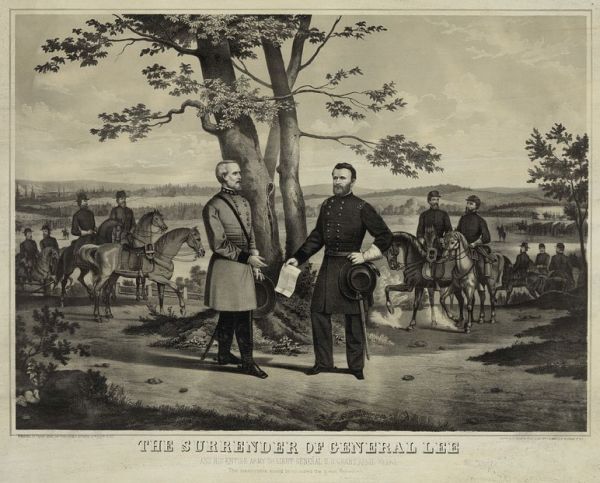
The surrender of General Robert E. Lee to General Ulysses S. Grant at Appomattox Court House
In 1865, the Civil War was nearing its end after years of fighting. As the war came to a close, questions remained about what would follow. Think about what the end of the fighting might mean for the nation, and share your thoughts in the discussion walls.
In what ways can a war continue even after the fighting ends?
What kinds of changes would help you decide whether the end of a war truly changed a nation?
When reviewing students’ responses on the discussion wall, guide the conversation toward how historical significance is shaped by time, perspective, and experience. Ask: Which changes following the war might have been immediate, and which ones would have taken years to unfold? Then extend thinking by asking: Who gets to decide whether a war truly changed a nation, and how might different groups judge its significance differently? Use these questions to help students see the end of the war as a turning point whose meaning was debated and uncertain, setting up the challenges the country still faced moving forward.
In this experience, you will learn how the Civil War came to an end and how its human and material costs reshaped lives across the nation, revealing why the war’s impact continued long after the fighting stopped.
Objectives: