Add a Curriculum Bundle to Your Account!
Please select a bundle.




The Pack contains associated resources for the learning experience, typically in the form of articles and videos. There is a teacher Pack (with only teacher information) and a student Pack (which contains only student information). As a teacher, you can toggle between both to see everything.
Here are the teacher pack items for Challenging Slavery:

Overview In this experience, students explore how growing resistance to slavery and reactions to it intensified national tensions in the mid-1800s. First, they analyze a political cartoon to uncover early conflicts over the expansion of slavery. Next, students examine different forms of resistance by enslaved people and abolitionists and the responses of enslavers to understand why fear and tightening control increased division. Then, students identify key events such as Bleeding Kansas and John Brown’s actions to explain how repeated violence and political conflict created a more unstable national climate. Finally, the Elaborate scene invites students to evaluate a mural of John Brown, using visual evidence to explain how shifting perspectives and rising tensions made cooperation increasingly difficult by the late 1850s. Estimated Duration: 45–60 minutes Vocabulary: Objectives:
This experience builds on earlier moments when national leaders tried to manage the expansion of slavery through compromise and political debate. Revisiting the Kansas-Nebraska Act, the idea of popular sovereignty, and the goals of Free Soilers helps frame how arguments over new land shifted from uneasy balance to open conflict. These concepts highlight why decisions about Western territories mattered so deeply, how different groups defined freedom and power, and why efforts to settle the issue of slavery instead created new tensions that shaped the road toward civil war.
As debates over slavery intensified in the years before the Civil War, conflicts over power, rights, and the future of the nation became increasingly public. These disagreements shaped how Americans understood events unfolding around them and how they expressed support or opposition to slavery.
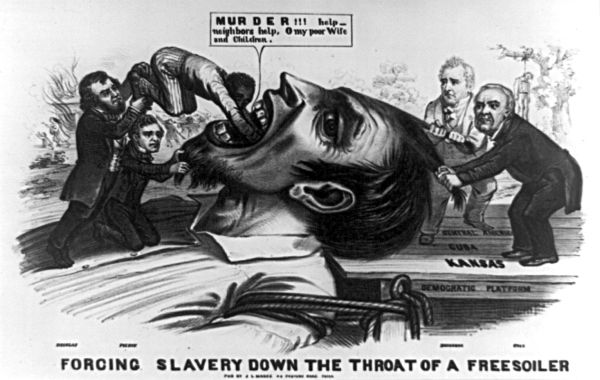
Observe the political cartoon carefully and record what you notice. Use the See-Think-Wonder chart to note what you see in the image, what you think it suggests about slavery and power, and what questions it raises for you.

When reviewing the class See–Think–Wonder chart, begin by surfacing students’ prior knowledge about the Kansas-Nebraska Act and who the Free-Soilers were. Highlight details that students noticed that connect to these ideas. Ask questions that help them link what they already know to what they see in the image, such as What do you notice here that connects to the idea of popular sovereignty? or How might someone who opposed the spread of slavery view this scene? Use their responses to help them recognize that cartoons often use exaggeration to express a political point of view.
In this experience, you will learn how growing resistance to slavery and the responses it provoked helped intensify national tensions and shape public debate in the years leading up to the Civil War.
Objectives: