Add a Curriculum Bundle to Your Account!
Please select a bundle.

The Pack contains associated resources for the learning experience, typically in the form of articles and videos. There is a teacher Pack (with only teacher information) and a student Pack (which contains only student information). As a teacher, you can toggle between both to see everything.
Here are the teacher pack items for Cooperation and Conflict in the Colonies:

Overview In this experience, students examine the changing relationships between colonists and Indigenous people by evaluating examples of cooperation and conflict between the two groups. First, students identify the benefits each group gained by forming relationships at the time of contact. Then, they explore cooperation and conflict by discussing the causes and effects of shifting relationships at a broader level. Next, students analyze how Plymouth and Jamestown colonists interacted with Indigenous groups and explain how these examples reflect the evolving nature of colonial-Indigenous relationships across North America. Last, students examine the dominant narrative of the First Thanksgiving and discuss how it illustrates changes in the relationship between the two groups. Estimated Duration: 45–60 minutes Vocabulary: Objectives:
When teaching history involving Indigenous communities, it is essential to understand that Indigenous peoples in North America are not a single group. They belong to hundreds of distinct nations, each with its own culture, government, language, and traditions. Because of this, not every Indigenous person identifies with every term associated with Indigenous people. Many Indigenous individuals today prefer to be identified by the name of their specific tribal nation, such as Wampanoag, Lakota, or Apache. You may encounter various terms in historical sources or videos, including Indian, Native American, Indigenous American, or Indigenous person. These terms are not interchangeable, and each carries different histories, associations, and meanings. This curriculum uses the term Indigenous person/people/group to reflect historical accuracy. This term recognizes the first peoples of North America without grouping them into a single identity. To support students in this understanding, help them think critically about language, avoid generalizations, and approach this topic with care by providing historical context, modeling precise terminology, and encouraging respectful discussion.
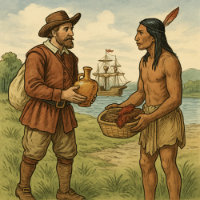
During the colonization of North America, Europeans and the Indigenous groups living there came into contact for the first time and formed new relationships. These encounters were shaped by the choices each group made, the needs they had, and how they viewed one another.
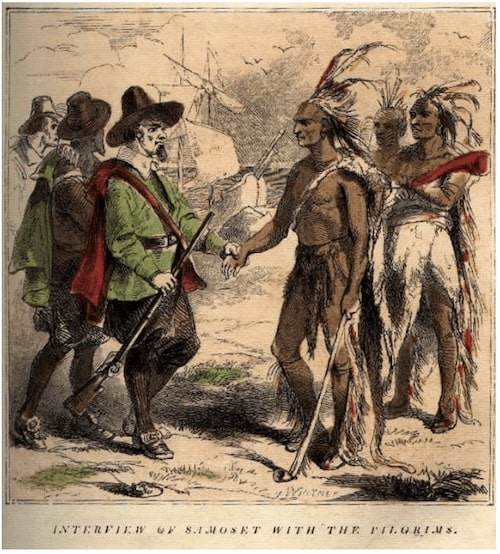
Interview of Samoset with the Pilgrims (Illustration 1)
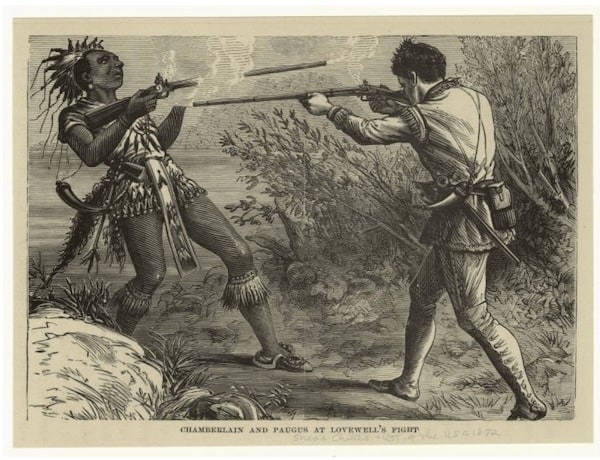
Chamberlain and Paugus at Lovewell’s Fight (Illustration 2)
Evaluate the two illustrations above. Then, answer both discussion questions to explain what each illustration shows about the relationships between colonists and the Indigenous people of North America.
Challenge yourself to use at least two complete sentences in your responses. When you finish, add new details to a classmate’s response to support their answer further.
What does the image, Interview of Samoset with the Pilgrims (Illustration 1), show about the relationships between colonists and Indigenous populations in North America?
Use details from the illustration to support your answer.
What does the image, Chamberlain and Paugus at Lovewell’s Fight (Illustration 2), show about the relationships between colonists and Indigenous populations in North America?
Use details from the illustration to support your answer.
To support students in analyzing historical images, focus on guiding them to look closely, notice details, and ask questions about the source. Help students understand that historians use images as evidence because they offer insight into how people in the past viewed events, groups, and relationships. Images can reflect a creator’s perspective, purpose, and the values of the time. These two illustrations show different moments of contact between colonists and Indigenous groups. Use this opportunity to prompt students to notice how the relationships are represented and how the illustrations suggest a change across time. Encourage students to support their ideas with specific visual evidence. To guide discussion, consider asking:
In this experience, you will trace the shifting relationships between colonists and Indigenous groups by exploring key events and turning points, and by identifying the causes and effects of those changes over time.
Objectives: