Add a Curriculum Bundle to Your Account!
Please select a bundle.

The Pack contains associated resources for the learning experience, typically in the form of articles and videos. There is a teacher Pack (with only teacher information) and a student Pack (which contains only student information). As a teacher, you can toggle between both to see everything.
Here are the teacher pack items for Colonial Arts and Literature:

Overview In this experience, students explore and evaluate American Colonial art, music, and literature by using secondary and primary sources to create a slide presentation to show how they reflected the values, beliefs, and experiences of colonial society. First, students complete a See-Think-Wonder chart to examine a colonial oil painting. Next, they work in groups to plan and create their presentations by evaluating a selection of curated primary and secondary sources, in addition to finding and evaluating another secondary source for relevant information. Then, they consider what art, literature, and music show about life and change in the colonies, while their classmates present their work. Finally, students complete a self-reflection on how well their team worked together and consider their own contributions. Estimated Duration: 55–65 minutes Vocabulary: Objectives:
This experience has students work with multiple primary and secondary sources. While they may have encountered these terms before, it is important to clarify the difference. Reviewing the meanings of the two types of sources before students begin will help them recognize the value and purpose of each type of source. Consider displaying brief examples side by side and asking students to identify which is primary and which is secondary, and why. This foundational understanding will support their analysis throughout the experience.
Art, music, and literature are not only forms of expression; they are sources of historical evidence. In colonial America, these creative works recorded and communicated ideas about daily life, belief systems, and major events that shaped society.
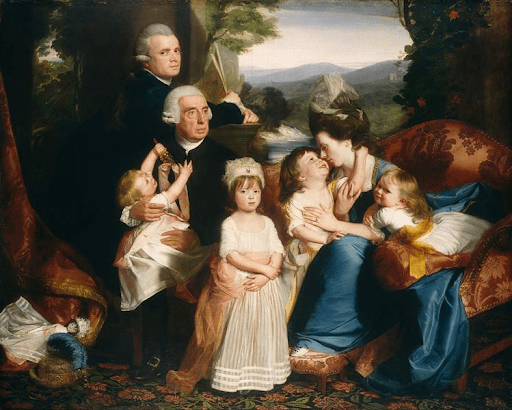
Painting by a colonial artist
Look at the painting above. Think about what it tells you about colonial life and society. Then, complete the See-Think-Wonder chart to record your ideas about the painting.
The purpose of the See-Think-Wonder chart is to guide students in analyzing unfamiliar images by separating observation, interpretation, and curiosity. It encourages careful looking and thoughtful reflection before drawing conclusions. To scaffold student thinking, consider modeling the process with a simple image or doing the first row as a class. Prompt students to describe only what is visible in the “See” section, without jumping to conclusions. In the “Think” section, encourage them to use phrases like “I think...because...” to show their reasoning. For the “Wonder” column, invite open-ended questions that connect to historical context or emotional response. After students share their responses, you may consider telling them that the title of the painting is The Copley Family, and it was painted by John Singleton Copley in 1776 or 1777. One of the small groups will research Copley later in the experience.
In this experience, you will gain background knowledge about the types of art, literature, and music present in the colonies. Then, you will work in small groups to analyze specific examples of colonial art, music, and literature. By examining primary and secondary sources, you will evaluate how these works reflect the values, beliefs, and experiences of the time.
Objectives: