Add a Curriculum Bundle to Your Account!
Please select a bundle.




The Pack contains associated resources for the learning experience, typically in the form of articles and videos. There is a teacher Pack (with only teacher information) and a student Pack (which contains only student information). As a teacher, you can toggle between both to see everything.
Here are the teacher pack items for Southern Coastal South America: Society and Culture:


Overview In this experience, students examine gaucho traditions in Argentina and consider how life on the Pampas has shaped work, customs, and cultural identity. They research asado as an Argentine social and food tradition and explain its cultural importance. Finally, students use evidence from a video and reading to interpret how gaucho life reflects adaptation to environment, work, and long-standing traditions. Objectives:
Southern coastal South America includes many cultural traditions shaped by Indigenous peoples, European colonization, migration, geography, and regional history. These influences can be seen in food, music, dance, language, celebrations, clothing, and other parts of daily life.
One well-known example comes from Argentina, where cattle ranching on the Pampas helped shape gaucho traditions and the custom of asado, a social meal centered on grilled meats. Asado is not simply a way of cooking. It can also be a gathering that brings family and friends together.
In this experience, you will explore cultural traditions in Argentina, Chile, and Peru and examine what they reveal about the societies and histories of the region.
Objectives:
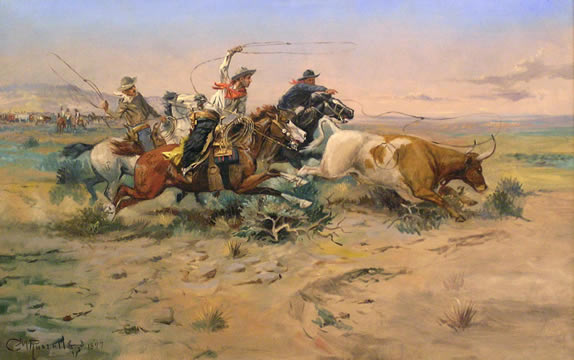
The Herd Quitter, by C.M. Russell
What are some ways you think the geography and history of Argentina, Chile, and Peru might influence their cultural traditions?
Student responses will vary. Encourage students to draw on what they already learned about the geography and history of Argentina, Chile, and Peru. Students may predict that geography influences foods, clothing, transportation, work, celebrations, or music, while history may influence language, religion, traditions, and cultural practices. Do not correct every prediction at this point. The goal is to activate prior knowledge and prepare students to notice how geography and history help shape culture as they move through the lesson.
When everyone is ready to continue, unlock the next scene.


