Add a Curriculum Bundle to Your Account!
Please select a bundle.



The Pack contains associated resources for the learning experience, typically in the form of articles and videos. There is a teacher Pack (with only teacher information) and a student Pack (which contains only student information). As a teacher, you can toggle between both to see everything.
Here are the teacher pack items for Southern Coastal South America: Government and Economy:


Overview In this experience, Students examine the governments and economies of Chile, Argentina, and Peru and consider how geography, natural resources, and historical development have influenced each country. In small groups, students research one country in greater depth and create a profile explaining its current government, major economic activities, resources, trade, and geographic influences. Finally, students investigate tourism in Patagonia and create a brochure showing how the region’s physical geography attracts visitors and supports economic activity. Students will work together in small groups for Scene 3. You should assign at least one group to cover each of the three countries: Chile, Argentina, and Peru. Objectives:
Chile, Argentina, and Peru are neighboring countries, but they have developed different political systems, economic strengths, and relationships between government and economic life. Each has a national government with elected leaders and laws that shape how the country is organized, how public decisions are made, and how resources are managed.
Their economies are also shaped by geography. The Andes Mountains, long coastlines, fertile farmland, mineral deposits, fishing grounds, and different climate regions all influence the kinds of industries that develop and the ways people earn a living.
In this experience, you will examine how the governments of Chile, Argentina, and Peru are organized, compare important parts of their economies, and explore how geography and government decisions help shape economic life in each country.
Objectives:
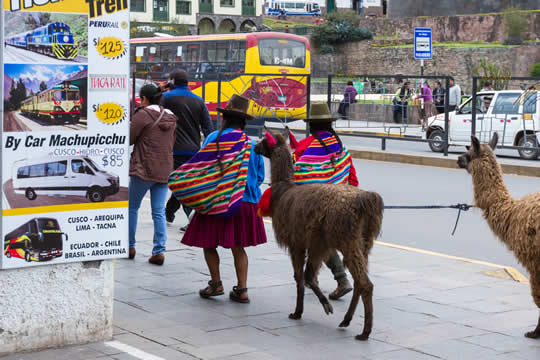
Woman Walking Llamas in Cusco, Peru
The geography of the Andes influences many parts of economic life in Peru, Chile, and neighboring countries. For thousands of years, people in the Andes have raised animals that are well suited to high elevations and rugged terrain.
One of these animals is the llama. Llamas have been used for transportation, wool, and other purposes, and they continue to support economic activity in some Andean communities today.
Read about Llamas. As you read, look for ways llamas are used and why they are especially well suited to life in the Andes.
How do llamas show the connection between geography and economic activity in the Andes? Use at least two examples from the reading.
As the interactivity notes, they can be used for transportation. Additionally, their wool is used for ropes, rugs, and fabrics; and their hide is used for leather. Their excrement can be used for fuel, and they can also be used for meat.
When everyone is ready to continue, unlock the next scene.


