Industrialization Review


Industrialization Review
This collaborative review guides students through reflection, vocabulary, and content practice to reinforce key learning. Interactive activities and optional writing help deepen understanding before a final exit ticket.

This learning experience is designed for device-enabled classrooms. The teacher guides the lesson, and students use embedded resources, social media skills, and critical thinking skills to actively participate. To get access to a free version of the complete lesson, sign up for an exploros account.

1:1 Devices
Teacher Pack

The Pack contains associated resources for the learning experience, typically in the form of articles and videos. There is a teacher Pack (with only teacher information) and a student Pack (which contains only student information). As a teacher, you can toggle between both to see everything.

Here are the teacher pack items for Industrialization Review:

Preview - Scene 1
Exploros Learnign Experience Scene Navigation


Engage


Overview

In this experience, students review and reinforce key learning from the unit through reflection, vocabulary, and content practice. First, students activate their knowledge by reflecting on big ideas and takeaways from the unit. Then, students work with a partner to review key vocabulary terms using flashcards and apply their understanding through a collaborative task. Next, students repeat this structure with important content from the unit, using flashcards and an interactive activity to make connections across what they’ve learned. Finally, the Elaborate scene invites students to extend their learning through an optional writing activity that asks them to respond to big-picture questions, followed by a short exit ticket aligned to key standards.

Estimated Duration: 45–60 minutes

Vocabulary Words and Definitions:

  • aqueduct: a structure built to carry water over long distances to where people live or farm
  • agrarian: related to farming and the use of land for growing crops or raising animals
  • artisan: a skilled worker who makes things by hand, such as tools, clothes, or art
  • Black Belt: an area of rich, dark farmland in the southern United States that was good for growing cotton
  • cotton gin: a machine invented by Eli Whitney that quickly removes seeds from cotton fibers
  • Deep South: the region of the southern United States below the Upper South, including Louisiana, Mississippi, Alabama, Georgia, and South Carolina, where cotton farming and slavery were most common before the Civil War
  • distribution: the process of delivering or sharing goods among people or places
  • estate: a large area of land with a big house, often owned by a wealthy family
  • famine: a severe shortage of food that leads to hunger for many people
  • foreman: a person who supervises and directs workers on a job site or in a factory
  • industrial: related to the making of goods in factories rather than by hand
  • industry: all the businesses that make products or provide services in a particular area
  • inheritance: money, land, or property passed from one person to another after death
  • ironworks: a place where iron is heated and shaped to make tools, machinery, or other metal products
  • Know-Nothing Party: a political group in the 1850s that opposed immigration and wanted to limit the influence of immigrants in the United States
  • manufacture: to make goods, especially in large amounts, using machines
  • mills: buildings or factories where materials like grain or cloth are processed or made
  • nativism: the policy or belief of favoring native-born people over immigrants, often by supporting restrictions on immigration
  • planter class: a group of wealthy landowners in the South who owned large plantations and forced enslaved people to labor on them
  • segregation: the forced separation of people based on race, religion, or other differences
  • tenement house: a crowded apartment building where many working-class families lived
  • textiles: cloth or fabric made by weaving or knitting fibers together
  • Upper South: the region of the southern United States north of the Deep South, including Virginia, West Virginia, Kentucky, North Carolina, Tennessee, Arkansas, and Oklahoma
  • urbanization: the growth of cities as more people move from rural areas to live and work there
  • wages: the money a person earns for the work they do
  • yeoman: a small farmer who worked his own land and usually did not own enslaved people
 

Objectives:

  • Reflect on and apply key vocabulary and content knowledge from the unit
  • Demonstrate understanding of major unit concepts through collaborative and written review activities

In this experience, students are asked to engage in group work and discussions. The experience is intentionally designed around questions that will elicit discussion, thinking, and application of learning as a review of the unit.


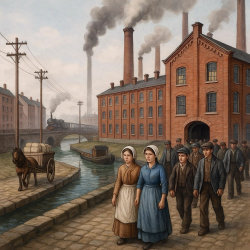
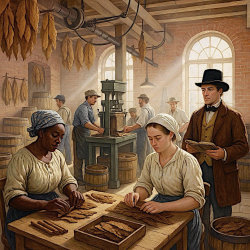
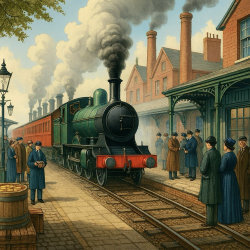
Throughout this unit, you’ve explored the first phase of the American Industrial Revolution, examining how new technologies, changing labor systems, and expanding industries transformed life in both the North and the South.

Objectives:

  • Reflect on and apply key vocabulary and content knowledge from the unit
  • Demonstrate understanding of major unit concepts through collaborative and written review activities


What do you think is the most important thing to understand about how the first phase of the American Industrial Revolution impacted the United States?

Post your answer

After students complete their individual reflections, consider facilitating a whole-class or small-group share-out. Ask several students to explain what they chose as most important and why. Encourage classmates to respond to each other’s ideas by making connections, asking follow-up questions, or offering alternative perspectives. This discussion helps deepen thinking and allows students to see how others interpreted the most important thing to understand about how the first phase of the American Industrial Revolution impacted the United States.

Organize Students into small groups of 2 or 3, which they will work in for the next scene. When everyone is ready to continue, unlock the next scene.

End of Preview
The Complete List of Learning Experiences in Industrialization Unit.
Would you like to preview the rest of this learning experience, and get access to the entire functioning US History Through 1877 course for your classroom? Sign up using your school email address below.
Back to top