Add a Curriculum Bundle to Your Account!
Please select a bundle.




The Pack contains associated resources for the learning experience, typically in the form of articles and videos. There is a teacher Pack (with only teacher information) and a student Pack (which contains only student information). As a teacher, you can toggle between both to see everything.
Here are the teacher pack items for African Americans During Industrialization:

Overview In this experience, students explore how industrialization affected the lives of both free and enslaved African Americans. First, they reflect on what they know about the relationship between industrialization and slavery by identifying words that describe how the two systems were connected. Next, students analyze the opportunities and limitations experienced by free Black Americans by watching a video and reading a text, then collaborating to compare their findings. Then, students examine how industrialization shaped slavery in the Upper and Deep South by comparing regional experiences and analyzing a firsthand narrative from Henry Bibb. Finally, the Elaborate scene invites students to investigate how Black entrepreneurship developed during industrialization and how both opportunity and inequality continued to shape African American life. Estimated Duration: 45–60 minutes Vocabulary Words and Definitions Objectives:
Students will work in groups in the Explore scene to investigate the impacts of industrialization on free African Americans and share their findings with the whole class. Consider looking ahead to the activity and readings to inform grouping so that students are prepared to analyze different aspects of opportunity and limitation in the discussion.
If needed, to support students in completing the Engage scene activities, help them understand what is meant by relationship by explaining that it refers to how two systems or ideas influence or depend on one another. Encourage them to consider how industrialization and slavery coexisted and to examine the ways they might have interacted or influenced each other’s development.
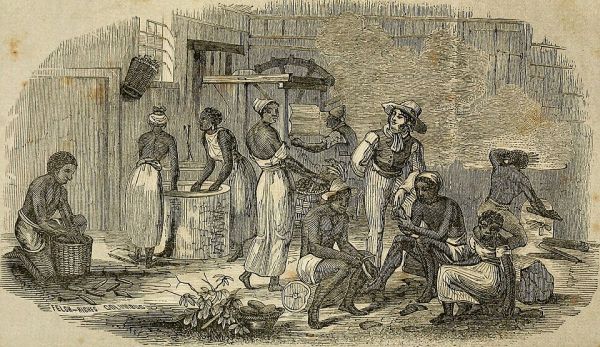
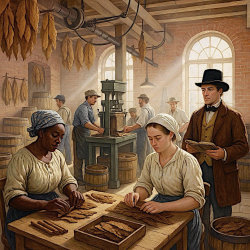
Illustration of enslaved African Americans
The first phase of the American Industrial Revolution transformed the United States in many ways, while other aspects of life remained largely unchanged. Think about industrialization and slavery and how they both shaped life in the nation at this time. Then, contribute one word to the class list to share your ideas about their relationship.
Describe the relationship between industrialization and slavery by adding one word or a short phrase to the class list. Try not to repeat words or phrases.

After students share their words, ask them to explain why they chose them and what relationship they see between industrialization and slavery. Ask: What connections or ideas do you notice across the words people added? Keep the focus on noticing shared themes or differences rather than drawing conclusions, since students will build on these ideas in the next activity.
Think about the connections and themes among the words in the class list. Then, complete the discussion wall to explain the relationship between slavery and early industrialization in the United States.
Write one sentence to explain the relationship between industrialization and slavery using two words from the class chart.
When reviewing students’ sentences, highlight examples that show clear connections between industrialization and slavery. Ask: What do these connections tell us about how one system depended on the other? Encourage students to notice patterns across responses, such as how growing industries increased the demand for enslaved labor or how the economy linked factories and plantations. Guide the discussion toward understanding that industrialization and slavery were not separate forces but parts of the same expanding economic system.
In this experience, you will learn how industrialization impacted the lives of enslaved and free African Americans across different regions, illustrating how systems of labor and freedom evolved in distinct yet interconnected ways in the North and South.
Objectives: