Add a Curriculum Bundle to Your Account!
Please select a bundle.



The Pack contains associated resources for the learning experience, typically in the form of articles and videos. There is a teacher Pack (with only teacher information) and a student Pack (which contains only student information). As a teacher, you can toggle between both to see everything.
Here are the teacher pack items for Tejanos and American Indians in the State of Texas:

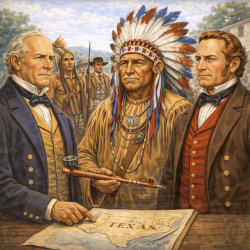
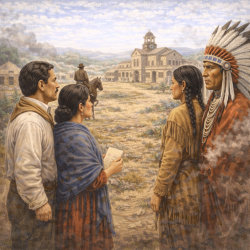
Overview In this experience, students examine challenges faced by Tejanos and American Indian nations during Texas’s early statehood period. They learn how some Tejanos experienced discrimination, threats, land loss, and declining political influence after annexation and the U.S.-Mexican War. They also analyze conflicts over land, the division of authority between the federal and state governments, the reservation system, and the removal of Indigenous communities from Texas. Finally, students examine a letter from Texas Ranger E. D. Burleson to Governor Elisha Pease to analyze how the Rangers responded to conflict and what the letter reveals about Burleson’s point of view. Students will collaborate in small groups for scene 2 and scene 3. Objectives:
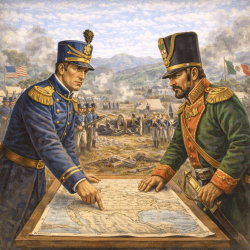
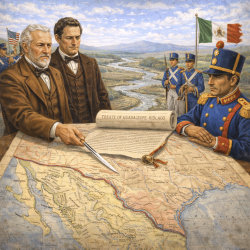
The U.S.-Mexican War had lasting effects on Texas and the United States. President James K. Polk strongly supported westward expansion, and the war ended with the United States gaining a large amount of territory from Mexico.
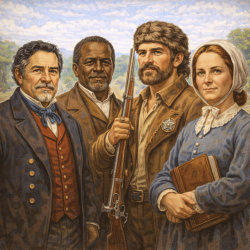
The war also affected Tejanos living in Texas. Tejanos were Texans of Mexican or Spanish heritage, and many had deep roots in the region. After annexation and the U.S.-Mexican War, some Anglo Texans questioned Tejano loyalty and treated them unfairly. Tejanos also faced growing pressure over land, political influence, language, and economic opportunities.
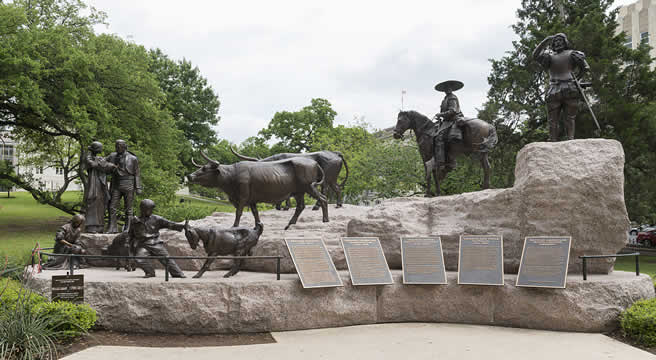
The Tejano Monument, Texas Capitol Grounds,
salutes Texas's first cowboys—Tejanos—and other Spanish-speaking settlers
In this experience, you will learn about the challenges faced by Tejanos and American Indian nations in Texas after annexation and during the early years of statehood.
Objectives:
Why might annexation and statehood create new challenges for people who were already living in Texas?
Answers will vary. Encourage students to think about how a change in government can affect people who already live in a place. Possible ideas may include: Tell students that they will examine how these kinds of changes affected Tejanos and American Indian nations during Texas’s early statehood period.
Divide students into their small groups for the next two scenes. When everyone is ready to continue, unlock the next scene.