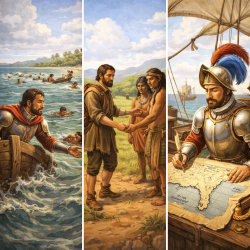
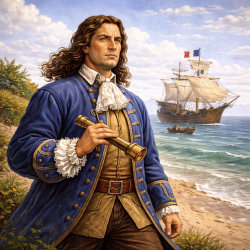
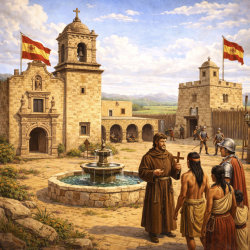
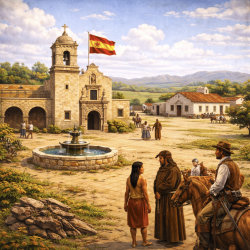
Spanish conquistadors, Cortez and the Aztecs, early Spanish explorers, La Salle and French Texas, the Mission-Presidio System, and Spanish settlement and colonization.
Exploration and Early Colonization unit contains 8 learning experiences.
Learning Experiences (Lessons) in Exploration and Early Colonization Each learning experience takes about 45 minutes to teach in the device-enabled classroom.
Spanish Conquistadors in the Americas
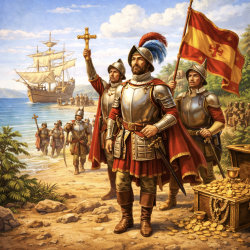
Students learn about Spanish exploration and conquest in the Americas and the motivations often summarized as “Gold, God, and Glory.” They examine how the search for wealth, the spread of Catholicism, and competition for power and territory shaped Spanish expeditions and colonization.
Cortes Conquers the Aztecs
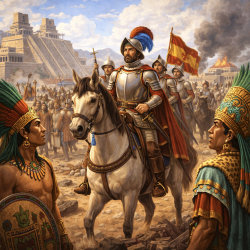
Students learn how Spanish forces led by Hernán Cortés and their Indigenous allies contributed to the fall of the Aztec Empire, and they build a timeline of key events. Then they read a biography of Cortés and examine the lasting effects of Spanish conquest and colonization in New Spain. Students also explore how point of view can influence interpretations of historical events.
Early Spanish Explorers
Students examine three early Spanish explorers connected to the history of the land that is now Texas: Pánfilo de Narváez, whose expedition ended in disaster; Álvar Núñez Cabeza de Vaca, a survivor who traveled through the region and later wrote about his experiences and encounters with Indigenous peoples; and Alonso Álvarez de Pineda, whose 1519 expedition mapped the Gulf Coast and produced the earliest known European map showing part of the Texas coast.
La Salle and French Texas
Students learn about French motivations for colonization in North America and La Salle’s goals in particular. They read about La Salle’s failed attempt to locate the mouth of the Mississippi River and the French settlement near Matagorda Bay known as Fort Saint Louis. They also examine how competition between France and Spain for territory, trade, and influence affected Spanish exploration and settlement in Texas.
The Mission-Presidio System
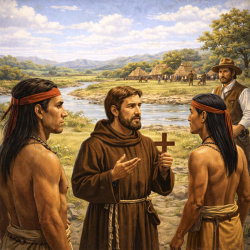
Students learn about the goals and structure of Spanish missions and presidios. Next, they explain how missions and presidios helped Spain strengthen its territorial claims and respond to French influence in Texas. Finally, they examine why Spain gradually reduced its support for some missions and presidios.
Spanish Settlement in Texas
Students learn about several forms of Spanish settlement and land use in Texas, including missions, pueblos, and ranches. They work in small groups to research a specific mission. Then they examine the early development of San Antonio and the cooperation and conflicts that developed between mission communities and private ranchers.
Spanish Colonization and Native Americans
Students examine the complex relationships between Spanish missionaries, settlers, soldiers, and Indigenous nations in Texas. They learn about several distinct Native peoples, their ways of life, and their varied relationships with the Spanish. Students also examine a passage by Father Francisco Hidalgo to consider his perspective toward Indigenous peoples. Finally, they investigate one historical issue from the era of Spanish colonization and explain it from two perspectives: a Spanish missionary and an Indigenous person affected by the mission system.