Add a Curriculum Bundle to Your Account!
Please select a bundle.



The Pack contains associated resources for the learning experience, typically in the form of articles and videos. There is a teacher Pack (with only teacher information) and a student Pack (which contains only student information). As a teacher, you can toggle between both to see everything.
Here are the teacher pack items for Israel and Its Neighbors: Society and Culture:

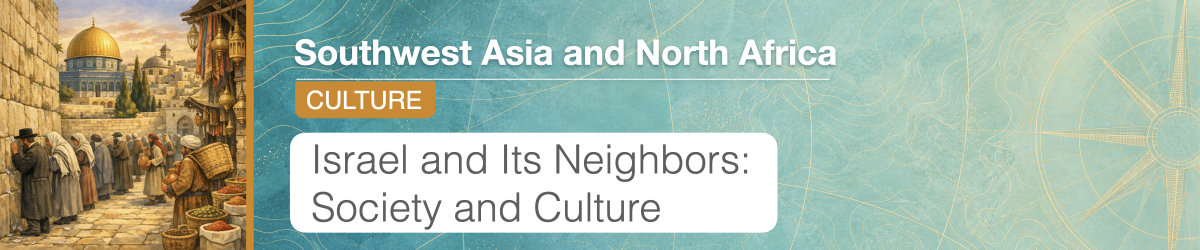
Overview In this experience, students examine how culture and cultural heritage are expressed in cities across Israel and its neighboring countries. They explore everyday life and religious traditions in Jerusalem, investigate how Jaffa’s past remains visible in the present, and then apply their understanding by researching a city in Jordan, Lebanon, or Syria and creating a travel brochure that highlights its cultural heritage. Objectives:
Jerusalem is a city where many parts of society and culture can be seen side by side. It is an important religious city for Jews, Christians, and Muslims, but religion is only one part of life there. Languages, foods, architecture, traditions, neighborhoods, schools, markets, music, and family life also reflect the people and communities who have shaped the city over time.
Jerusalem is also a place where different cultural traditions meet. Some traditions have been practiced for generations, while others have changed as people have migrated, interacted with neighboring communities, and adapted to modern life. Looking closely at the city can help us see how culture is expressed in both everyday life and important institutions.
Jerusalem cannot represent every community in Israel and its neighboring countries, but it provides one place to begin examining the similarities, differences, and cultural connections found across the region.
In this experience, you will explore aspects of society and culture in Jerusalem and the surrounding region, including religion, language, traditions, daily life, and the ways cultures influence one another.
Objectives:
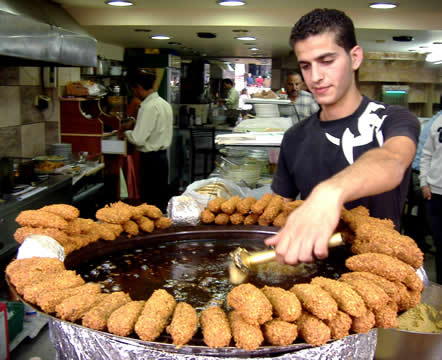
Falafel in Ramallah, Palestinian Territories
One way to learn about a society is to observe places where people gather in everyday life. Markets can reveal what people eat, what they buy and sell, how people interact, and how older traditions exist alongside modern life.
Mahane Yehuda Market is a large, historic market in Jerusalem. It began developing in the late 1800s as farmers and merchants sold food and other goods outside Jerusalem’s Old City. Over time, it grew into a network of streets, stalls, and shops. Today, people visit the market to buy fruits, vegetables, spices, baked goods, meat, household goods, and prepared foods. The market also includes restaurants and gathering places and remains an important part of daily life in Jerusalem.
Watch the first 2 to 3 minutes of the video tour of Mahane Yehuda Market. As you watch, pay attention to the people, foods, shops, movement, and sounds you notice.
Describe the sights and sounds you observe in the video. Based on what you see and hear, what do you think it might feel and smell like to walk through Mahane Yehuda Market?
After students respond, invite several students to share specific details they noticed in the market. Encourage them to separate what they directly observed from what they inferred about how the market might feel or smell. Use the discussion to connect the market to the larger idea of society and culture. Students may notice foods, patterns of shopping, social interaction, architecture, signs, sounds, or the mix of traditional and modern features. Reinforce that one market cannot represent an entire city or region, but it can provide evidence about everyday life in a particular place. Possible follow-up questions include:
When everyone is ready to continue, unlock the next scene.


