

Lesson
North Africa: Geographic Passport

Students are introduced to the physical geography of North Africa. They create a map that identifies significant physical features of the region. Then they focus on the connection between North Africa’s geographic location and the migration patterns, religious beliefs, and languages in North Africa. Finally, they research the issue of desertification, explaining its causes and possible solutions.
Product in action
Preview scene 1

- Identify the physical features of North Africa.
- Identify the connection between North Africa’s geographic location and its migration patterns, religious beliefs, and languages.
- Describe the problem of desertification and suggest possible solutions.
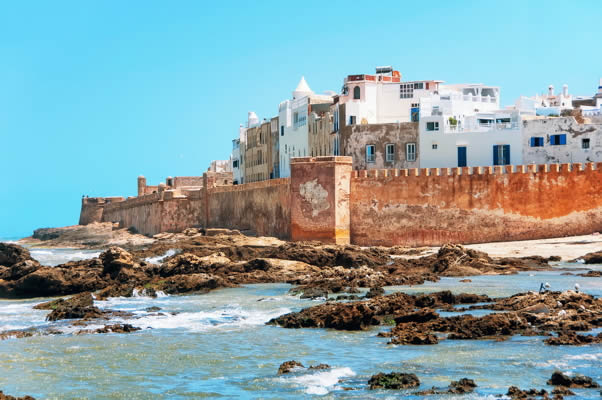
Describe what you see in this photo. Where do you think it is located?
Discuss student responses and then tell them that it is located in Morocco, a country in North Africa.
Encourage students to discuss the reasons for their guesses. Although most students may not be able to identify Morocco, you might point out clues to the location, such as the sea, the sunny and warm-looking atmosphere, the style and predominantly light colors of the buildings, and the medieval-looking fortifying wall around the city.-
Identify the physical features of North Africa.
-
Identify the connection between North Africa’s geographic location and its migration patterns, religious beliefs, and languages.
-
Describe the problem of desertification and suggest possible solutions.
Write a question you have about North Africa. If someone has already posted your question, try to think of a different one.

Continue the experience
Teach the complete lesson with Exploros.
See how staged content, student participation, and teacher guidance work together across the full learning experience.
Southwest Asia and North Africa
More lessons in this unit
 Arabia and Iraq: Geographic Passport
 Israel and Its Neighbors: History and Its Influence
 North Africa: Government and Economy
 Religion and Its Influence: The Origins of the Abrahamic Religions
 North Africa: Society and Culture
 Israel and Its Neighbors: Geographic Passport
 North Africa: Society and Culture
 Arabia and Iraq: Government and Economy
 Religion and Its Influence: The Origins of the Abrahamic Religions
 Turkey to Afghanistan: Government and Economy
 Arabia and Iraq: History and Its Influence
 Turkey to Afghanistan: History and Its Influence
 Israel and Its Neighbors: Government and Economy
 North Africa: Geographic Passport
 Arabia and Iraq: Society and Culture
 North Africa: History and Its Influence
 Israel and Its Neighbors: Geographic Passport
 Arabia and Iraq: Society and Culture
 North Africa: History and Its Influence
 Turkey to Afghanistan: Geographic Passport
 Israel and Its Neighbors: Society and Culture
 Israel and Its Neighbors: Government and Economy
 Religion and Its Influence: The Origins of Islam
 Southwest Asia and North Africa: Unit Review
 Religion and Its Influence: The Origins of Islam
 Turkey to Afghanistan: Government and Economy
 Turkey to Afghanistan: Society and Culture
 North Africa and the Middle East: Unit Review
 Israel and Its Neighbors: History and Its Influence
 Arabia and Iraq: Government and Economy
 Turkey to Afghanistan: History and Its Influence
 North Africa: Government and Economy
 Turkey to Afghanistan: Society and Culture
 Arabia and Iraq: History and Its Influence
 Israel and Its Neighbors: Society and Culture
 Turkey to Afghanistan: Geographic Passport
 Arabia and Iraq: Geographic Passport