Add a Curriculum Bundle to Your Account!
Please select a bundle.


The Pack contains associated resources for the learning experience, typically in the form of articles and videos. There is a teacher Pack (with only teacher information) and a student Pack (which contains only student information). As a teacher, you can toggle between both to see everything.
Here are the teacher pack items for Southern and Eastern Africa: History and Its Influence, Part 1:

Overview In this experience, students trace the development of societies in Eastern and Southern Africa from early states and trade networks through European colonial rule. They examine how trade, resources, and connections with other regions influenced societies such as Aksum and Great Zimbabwe, then analyze how colonialism changed control of land, labor, resources, and political power. Finally, students compare these earlier relationships with settler colonialism in Southern Africa to explain how outside influence affected the region in different ways. Objectives:
The history of Eastern and Southern Africa stretches across thousands of years. Long before European colonial rule, people in these regions built communities, developed systems of government, raised crops and livestock, traded valuable goods, and formed states that connected different parts of Africa with regions across the Red Sea and Indian Ocean.
Some societies grew powerful because of their location along trade routes or their access to valuable resources. Others developed political systems suited to local environments and communities. These societies also changed over time as people migrated, traded, competed for resources, and interacted with groups from other regions.
Beginning in the late 1800s, European colonial powers took political control over much of Eastern and Southern Africa. Colonial governments changed systems of land ownership, labor, trade, and political power that had developed over centuries.
In this experience, you will trace the development of societies in Eastern and Southern Africa and examine how trade, resources, and colonial rule changed political and economic relationships over time.
Objectives:
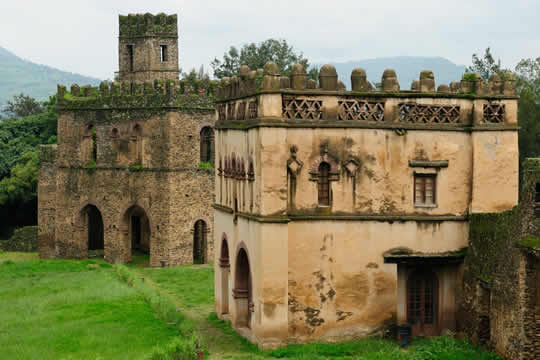
Castle in Gonder, Ethiopia
What detail in this image stands out to you most? Respond with one word or a two-word phrase. To list more than one, separate the details with a comma, like this: Rome, Paris.
After students respond, invite several students to identify the visual evidence that led to their response. Use the discussion to distinguish observation from inference. Students may notice the size of the buildings, stone construction, towers, walls, or other architectural features. Ask what those details might suggest about political organization, labor, technology, or wealth, while emphasizing that the image alone cannot answer those questions. Explain that students will encounter several societies in this experience and will use historical evidence to investigate how they developed and changed. Possible follow-up questions include:
When everyone is ready to continue, unlock the next scene.


