Add a Curriculum Bundle to Your Account!
Please select a bundle.



The Pack contains associated resources for the learning experience, typically in the form of articles and videos. There is a teacher Pack (with only teacher information) and a student Pack (which contains only student information). As a teacher, you can toggle between both to see everything.
Here are the teacher pack items for India: Population Challenges:

Overview: In this experience, students examine the scale of India’s population and consider how a very large population can create both opportunities and challenges. They investigate specific population-related challenges and analyze how population size interacts with factors such as infrastructure, resources, technology, economic conditions, and government decisions. Finally, students use evidence from their research to explain these relationships in an academic written response. Students should be divided into small groups for Scene 3. Objectives:
India has the largest population of any country in the world. More than 1.4 billion people live there, which means roughly one out of every six people on Earth lives in India.
A population this large can be an important source of workers, consumers, ideas, and economic activity. It can also create challenges when many people need housing, transportation, schools, health care, jobs, food, water, and other resources.
In this experience, you will examine the scale of India’s population, investigate some challenges connected to supporting a very large population, and use evidence to explain how population size can affect a country.
Objectives
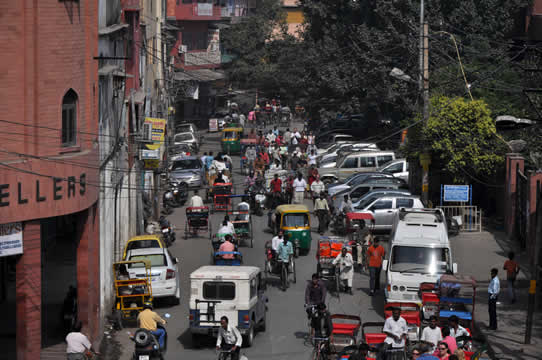
Old Delhi, India
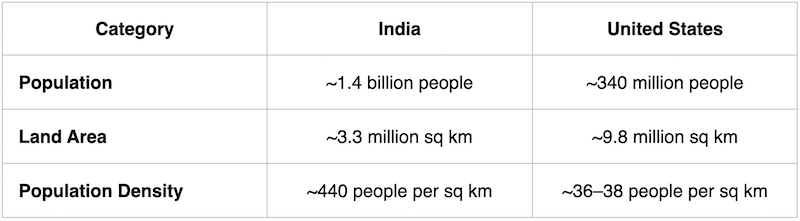
Use the information about India and the United States’ population to complete the See-Think-Wonder chart.

After students complete the table, invite several students to share one observation and one question. Use the discussion to establish the enormous scale of India’s population without treating population size itself as a problem. Students may predict that a large population could increase demand for housing, transportation, jobs, schools, health care, food, water, or other services. They may also recognize that a large population can provide workers, consumers, and economic opportunities. Possible follow-up questions include:
When everyone is ready to continue, unlock the next scene.


