Add a Curriculum Bundle to Your Account!
Please select a bundle.


The Pack contains associated resources for the learning experience, typically in the form of articles and videos. There is a teacher Pack (with only teacher information) and a student Pack (which contains only student information). As a teacher, you can toggle between both to see everything.
Here are the teacher pack items for Central America and the Caribbean: Government and Economy:


Overview In this experience, students examine the governments and economies of Central America and the Caribbean. They learn about major government systems in the region and how historical experiences helped shape them. Next, they explore important economic activities, including agriculture, tourism, manufacturing, trade, and services, and consider how geography and government influence economic life. Finally, students research one country or territory in greater depth and create a country passport highlighting its government, economy, and key connections between them. Objectives:
The countries of Central America and the Caribbean have different governments and economies. Some are republics with elected leaders, while others have different political structures. Their economies also vary depending on factors such as natural resources, agriculture, manufacturing, tourism, trade, and government policies.
In this experience, you will first examine patterns in government across Central America and the Caribbean. Then you will explore the region’s economies and the activities that support them. Finally, you will research one country in greater detail and create a country passport showing how its government and economy work.
Objectives
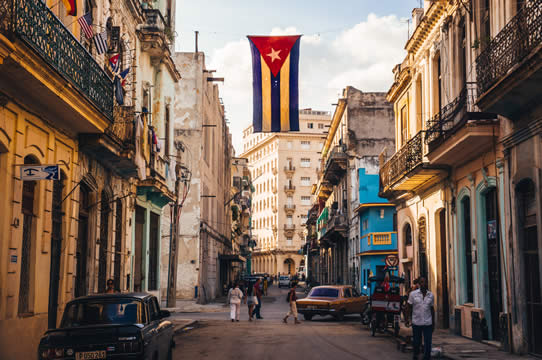
Havana (Capital City), Cuba, 2015
How might features such as climate, coastlines, natural resources, and landforms affect the ways people earn a living in Central America and the Caribbean? Post one prediction in the table below. You do not need to know the correct answer yet. Use what you know about the region’s geography to explain your thinking.

Use student responses to get a sense of how well they can connect geographic features to possible economic activities. Look for predictions related to farming, fishing, tourism, trade, natural resources, or transportation. Do not correct every prediction at this point. Students will revisit these ideas as they learn more about the economies of Central America and the Caribbean. Students do not need to post in the table in order to proceed to the next scene.
When everyone is ready to continue, unlock the next scene.


