Add a Curriculum Bundle to Your Account!
Please select a bundle.



The Pack contains associated resources for the learning experience, typically in the form of articles and videos. There is a teacher Pack (with only teacher information) and a student Pack (which contains only student information). As a teacher, you can toggle between both to see everything.
Here are the teacher pack items for Life in the Texas Settlements:


Overview In this experience, students first brainstorm names of Austin downtown streets; all north-south running streets are named for rivers. Then students summarize details about different areas of life within the Texas settlements. Next they find a photo of a dog-trot house and infer how its structure helped residents adapt to the Texas climate. Finally they write a journal entry describing their life in the Austin Colony. Note that there are three interrelated experiences that deal with settlement of Texas in the period of 1821–1830: There are two general resources provided in the Student Pack in all three experiences: a timeline of events in Texas history from 1826–1842 and a video (30 minutes). You can refer students to these resources at any point during these experiences. If you have access to leveled readers about life in a Texas colony during the Mexican colonial period, assign them to the students in parallel to this experience. Estimated duration: 45-55 minutes Discovery Reading A printable Discovery Reading is included in the student pack as a support for understanding the experience’s core content and concepts. This Discovery Reading is not necessary to complete the experience and serves as an optional support resource. Vocabulary Words: These vocabulary words are used in the experience or connect closely to the standards and content students examine. Students should understand these terms as they work through the experience. Objectives
You have learned about the Mexican government’s policies concerning Anglo immigration to Texas and how Stephen F. Austin established his colony. In this experience, you will learn about life within the colonies.
Objectives
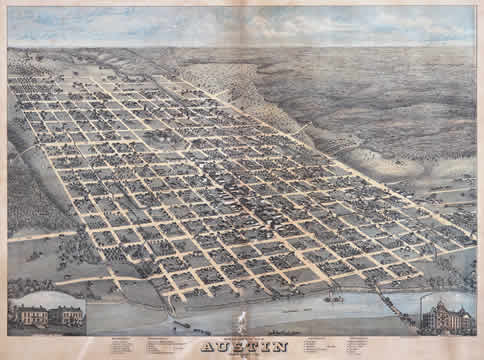
Map of Austin, Texas, 1873
The Texas state capital, Austin, was named after Stephen F. Austin. The streets that border the two sides of the capitol building grounds are Colorado Street and San Jacinto Blvd., both named for major Texas rivers.
Austin has streets named after rivers, trees, and important people. Why do you think city planners choose names like these? What do street names tell us about what a place values or wants people to remember?

Guide students to the idea that street names are often chosen on purpose. They can honor important people, remind us of Texas geography, or reflect what a city wants to remember about its history. Help students notice that names like Colorado and San Jacinto connect to Texas places and events. Accept responses such as honoring history, showing pride in Texas, helping people remember important places, or reflecting what mattered to the city when it was planned. The goal is not for students to know Austin street names from memory, but to begin thinking about how place names can tell us something about a community.