Add a Curriculum Bundle to Your Account!
Please select a bundle.





The Pack contains associated resources for the learning experience, typically in the form of articles and videos. There is a teacher Pack (with only teacher information) and a student Pack (which contains only student information). As a teacher, you can toggle between both to see everything.
Here are the teacher pack items for Your State and Local Governments:


Overview In this experience, students define the word federal as a refresher. Then they read the Tenth Amendment and create a Venn diagram of the federal and state governments. Next they explore local governments and explain why most Americans have more contact with state and local governments than with the federal government. Finally, students practice finding contact information for public officials at all levels. Estimated duration: 40-50 minutes Discovery Reading A printable Discovery Reading is included in the student pack as a support for understanding the experience’s core content and concepts. This Discovery Reading is not necessary to complete the experience and serves as an optional support resource. Vocabulary Words: These vocabulary words are used in the experience or connect closely to the standards and content students examine. Students should understand these terms as they work through the experience. Objectives
You have learned about the federal government throughout this course on American History. In this lesson, you will learn about two additional levels of government that provide you with services—your state and local governments.
Objectives
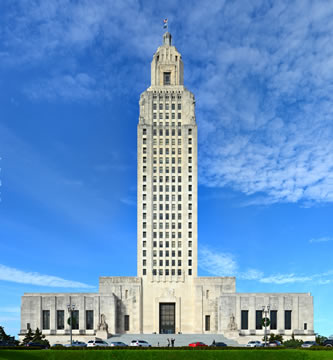
The Louisiana State Capitol building in Baton Rouge
is currently the tallest capitol building in the United States
The national government is often referred to as the federal government. The federal government has responsibilities that affect the entire country, while state and local governments have responsibilities that affect people closer to where they live. In the table, name one responsibility of the federal government.

Possible answers include responsibilities such as national defense, managing relations with other countries, printing money, or making and enforcing federal laws. Use students’ responses to briefly reinforce that the federal government handles responsibilities that affect the nation as a whole. Then transition to how state and local governments have their own responsibilities.
When everyone is ready to continue, unlock the next scene.


