Add a Curriculum Bundle to Your Account!
Please select a bundle.



The Pack contains associated resources for the learning experience, typically in the form of articles and videos. There is a teacher Pack (with only teacher information) and a student Pack (which contains only student information). As a teacher, you can toggle between both to see everything.
Here are the teacher pack items for Modern U.S. Political Parties:


Overview In this experience, students examine the elephant and donkey political symbols and make a prediction about why political parties use symbols to represent themselves. Then they compare and contrast the two major political parties. Next they identify leadership qualities. Finally, they research the job responsibilities of the leaders within the government. Estimated duration: 35-45 minutes Discovery Reading A printable Discovery Reading is included in the student pack as a support for understanding the experience’s core content and concepts. This Discovery Reading is not necessary to complete the experience and serves as an optional support resource. Vocabulary Words: These vocabulary words are used in the experience or connect closely to the standards and content students examine. Students should understand these terms as they work through the experience. Objectives
A political party is an organized group of people who share many ideas about government and public issues. Members of a political party do not always agree on every issue, but they work together to elect candidates and promote shared goals and policies.
Many political parties have existed in the United States since the nation was founded. Some, such as the Free-Soil Party and the Know-Nothing Party, were important for a time but no longer exist as major parties.
Today, the two major political parties in the United States are the Democratic Party and the Republican Party. In this lesson, you will learn about the ideas, goals, and roles of these two parties in U.S. government and elections.
Objectives
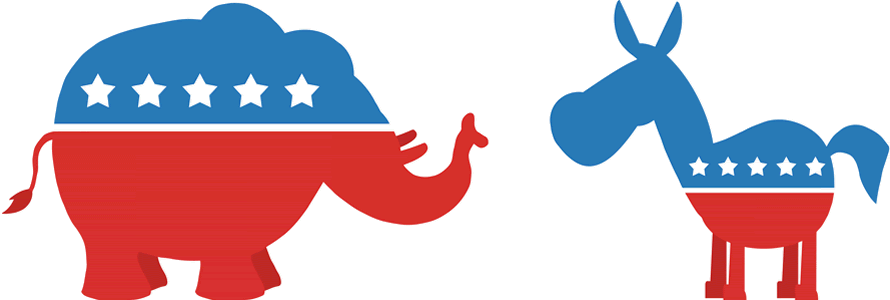
Look at the picture shown above—an elephant and a donkey.
Look closely at the donkey and elephant symbols. What details do you notice? Why do you think political parties might use symbols to represent themselves?
Use students’ observations to begin a brief discussion about why political parties use recognizable symbols. If students already know that the donkey and elephant are associated with the Democratic and Republican parties, invite them to explain how they know. Do not require students to identify the parties from the symbols at this point. Students will learn more about the two major parties in the next scene. Students who are interested in the history of the symbols can read the article in the Student Pack.
When everyone is ready to continue, unlock the next scene.


