
Why the 5E Model Belongs in Social Studies
(10 minute read)
The 5E model is often associated with science classrooms, and for good reason. It gives students a structure for investigating a phenomenon, working with evidence, developing explanations, and applying what they learn. But that same structure has enormous value beyond science because 5E is not simply a science model. It is an inquiry model, and that matters for social studies.
At its best, social studies is built around inquiry. Students investigate people, places, ideas, systems, choices, power, conflict, continuity, and change. They examine evidence. They interpret maps and data. They read sources closely. They compare perspectives. They ask why events happened, how communities developed, how governments work, how economies shape decisions, and how people participate in civic life.
That kind of learning needs more than content delivery. It needs a structure that helps students move from curiosity to evidence, from evidence to understanding, and from understanding to application. That is why the 5E model is such a powerful fit for high-quality social studies instruction.
Coverage and Inquiry Can Feel Like Competing Goals
Social studies teachers are asked to do a lot. They teach historical eras, geographic patterns, economic systems, civic structures, cultural developments, government institutions, primary sources, vocabulary, maps, graphs, charts, and standards-based skills. They are often expected to cover broad timelines and complex concepts while also helping students develop literacy, reasoning, and communication skills, all within 45-minute class periods and 180 days or less of instruction.
The pressure to “get through the content” is real. When that pressure grows, social studies can become a march through facts, dates, terms, names, and definitions. Students may learn what happened, but not always why it mattered. They may memorize the branches of government, but not understand how governing actually works. They may identify places on a map, but not analyze how geography shaped human decisions. They may read a source, but not use it to build an evidence-based explanation.
At the same time, inquiry can sometimes feel like something extra: a project, a discussion, a source activity, or an extension added after the “real” lesson. That framing creates a false choice. It suggests that teachers can either cover the standards or give students rich opportunities to think, investigate, and apply ideas.
The strongest social studies classrooms do not treat standards and inquiry as competing goals. They use inquiry to teach the standards more meaningfully. Standards provide essential building blocks: the content, concepts, vocabulary, and skills students need. But the goal is not for students to collect those building blocks and leave them in a pile. The goal is for students to use them to construct understanding of the world around them.
That is where 5E helps. The model gives teachers a clear instructional arc: engage students in a question or problem, let them explore evidence and ideas, help them explain and clarify understanding, give them space to elaborate or apply learning, and then evaluate what they know and can do. In social studies, that arc can transform standards coverage into active learning.
Social Studies Rigor Is More Than Knowing and Doing
A lot of social studies instruction is organized around what students need to know and what students need to do. That makes sense. Students need content knowledge. They need vocabulary, historical context, geographic concepts, civic structures, economic principles, and disciplinary skills. Research on reading comprehension has long suggested that background knowledge is important. Those findings should not be oversimplified into a single rule about reading, but they do reinforce an important idea for social studies: what students already know can shape what they are able to understand. So knowing matters. Students need knowledge because knowledge gives them something to think with. Doing matters too. Students need to read sources, interpret maps, answer questions, complete organizers, write responses, and participate in discussions. But knowing and doing are not the final goal of social studies. They are the means to something deeper: thinking and learning.
When social studies stops at knowing, students can experience facts as disconnected pieces of information. They may remember a date, term, person, amendment, landform, or event long enough to answer a question, but the content does not always attach to a larger idea. There is no conceptual “sticky paper” for the facts to hold onto. The information may be accurate, but it does not necessarily help students understand a phenomenon, system, conflict, pattern, or concept.
Similarly, when social studies stops at doing, the work can also lose meaning. Students complete the activity, submit the organizer, answer the prompt, or participate in the discussion, but the task may end as a transaction between student and teacher. The product gets turned in, graded, and discarded without changing how students understand the world.
Inquiry changes that.
In an inquiry-based classroom, knowing and doing matter because they serve thinking and learning. Facts become evidence. Vocabulary becomes a tool for explanation. Reading becomes an investigation. Writing becomes meaning-making. Discussion becomes a way to test, build, and refine ideas. Skills become part of how students understand people, places, systems, choices, and consequences.
This is where the 5E model strengthens rigor in social studies. It gives teachers a structure for moving students beyond isolated knowledge and isolated tasks. Students engage with a meaningful question or tension, investigate evidence, build understanding, apply ideas, and demonstrate what they have learned. The result is not less content, it is content with a framework and content and skills with a purpose.
That is the kind of rigor social studies needs: not just students knowing more or doing more, but students thinking more deeply with what they know and do.
5E Works Because Social Studies Is Inquiry
Some educators may not immediately connect 5E to social studies because they associate the model with lab-based learning where students investigate scientific phenomena. But social studies has its own phenomena and points of inquiry worth studying. A political cartoon can be a phenomenon. A population map can be a phenomenon. A Supreme Court decision can be a phenomenon. So can a historical photograph, a civic dilemma, a trade route, a protest movement, a budget choice, a migration pattern, a secondary source interpretation, a short video, a news excerpt, a data set, a primary source, or a conflicting set of perspectives.
Each of these can invite students to ask: What is happening here? Why does it matter? What evidence helps us understand it? What does this reveal about people, places, power, choices, systems, or change?
Social studies inquiry begins when students encounter something worth investigating. The 5E model helps teachers organize that investigation. It gives students time to wonder, examine, make meaning, extend, and demonstrate understanding. It also gives teachers a repeatable structure for engaging students in lessons that are active without being unstructured. In other words, 5E is not a script. It is an instructional architecture. It helps teachers create a learning sequence that supports both standards mastery and deeper thinking.
What 5E Looks Like in Social Studies
In social studies, each phase of the 5E model has a disciplinary purpose. The phases should not feel like generic steps placed on top of a lesson. They should reflect the way students learn and build understanding: by activating prior knowledge, encountering meaningful questions, investigating evidence, clarifying concepts, applying ideas, and using what they know and do to think more deeply.
Engage: Start with Student Thinking
Engage is not the place to explain everything. It is the place to create a reason to learn. In social studies, an Engage might begin with a question, image, quote, map, artifact, political cartoon, short scenario, poll, video clip, headline, or dilemma. The goal is to activate what students already think and surface the tension that will drive the lesson.
A government lesson might begin by asking students whether free speech should ever be limited. A geography lesson might begin with a map showing an unexpected population pattern. A history lesson might begin with two conflicting accounts of the same event, a short secondary source that frames a problem, or a video clip that introduces a moment of tension. An economics lesson might begin with a choice involving scarcity and tradeoffs. In each case, the opening move helps students activate prior knowledge, lived experience, curiosity, or initial assumptions so the new learning has something to connect to.
The purpose is not to settle the issue immediately. The purpose is to make student thinking visible and create a need for evidence. When students begin by thinking, noticing, wondering, or taking a position, the content that follows has somewhere to land.
Explore: Investigate Sources and Gather Evidence
Explore is where students begin building the evidence base for understanding. In social studies, students might work with primary sources, secondary sources, maps, graphs, charts, timelines, photographs, political cartoons, videos, short readings, case studies, artifacts, or data sets. They may compare examples, identify patterns, sort information, make observations, or gather evidence.
The key is that students are not simply being told what to think. They are encountering the material that will help them develop understanding. Explore gives students something to reason from.
This can look different depending on the content. Sometimes students need an accessible article, short text, or media source that introduces key concepts before they analyze more complex evidence. Sometimes they begin with examples and build toward a larger idea. Sometimes the lesson moves from a broad pattern to a focused case study, or from one perspective to another. In a strong social studies lesson, the middle of the experience is designed intentionally around the kind of thinking students need to do.
That flexibility is important because social studies is not one kind of thinking. It includes sourcing, contextualizing, comparing, explaining cause and effect, analyzing change over time, interpreting maps, weighing civic tradeoffs, and recognizing patterns across evidence.
Explain: Make Meaning from Evidence
Explain is where students begin to consolidate understanding. This does not mean the teacher simply gives the answer. In social studies, Explain is often a guided meaning-making phase. Students clarify vocabulary, connect evidence to concepts, explain relationships, and develop more precise understanding.
For example, students might use evidence from several sources to explain why a revolution occurred. They might connect a map pattern to migration or settlement. They might define a civic concept after seeing it in action. They might compare perspectives and explain how each reflects a different value or interest.
Explain is where students move from noticing to understanding. This phase is especially important in social studies because students often encounter complex ideas: liberty, power, scarcity, sovereignty, culture, rights, citizenship, economic choice, historical causation, and geographic relationships. These ideas are not learned well through memorization alone. Students need to see them in context, use them, discuss them, and connect them to evidence.
Elaborate: Extend, Transfer, and Go Deeper
Elaborate may be the most underappreciated phase for social studies. Some of the richest learning happens when students apply what they have learned to a new question, current issue, local connection, case study, discussion, project, or skill-based task. This is where students can deepen inquiry and transfer understanding.
A history class might apply a concept from one time period to a different historical case. A government class might use constitutional principles to analyze a contemporary policy debate. A geography class might compare two regions facing similar environmental challenges. An economics class might ask students to apply incentives, tradeoffs, or opportunity cost to a real-world decision.
Elaborate gives teachers room to go deeper without losing the core learning progression. It can support student interest, differentiation, civic discussion, extended writing, local relevance, or disciplinary skill practice. It also gives teachers a way to meet students where they are. Some students may need more practice with the core concept. Others may be ready to apply the idea in a more complex context. Some may be drawn into the lesson through a contemporary connection, local issue, debate, or project.
This is especially valuable in social studies because students often need opportunities to practice thinking, not just recall content. They need to reason with evidence, listen across perspectives, interpret complexity, and apply ideas beyond the first example they encounter. Elaborate protects that space.
Evaluate: Demonstrate Understanding
Evaluate gives students the opportunity to show what they know and can do. In social studies, evaluation should assess the understanding students have built across the experience. That may include content knowledge, vocabulary, source analysis, map and data interpretation, evidence-based reasoning, writing, or civic understanding.
Strong evaluation does not surprise students with disconnected content. It measures the learning that has been developed and stabilized through the inquiry. Students should be asked to demonstrate understanding of the concepts, relationships, and skills they have had meaningful opportunities to build.
5E Gives Standards Their Proper Place
One of the most important benefits of the 5E model is that it helps social studies teachers give standards their proper place. Standards are essential. They define the content, concepts, and skills students are expected to learn. They help ensure coherence, accountability, and access to important knowledge.
But standards are not the same thing as learning.
A standard might require students to identify a principle, explain a cause, analyze a document, interpret a map, compare systems, or describe a historical development. Those are important expectations, but students still need an instructional pathway that helps them build the schema and understanding behind the expectation.
The 5E model provides that pathway. Instead of treating standards as a checklist of items to mention, 5E turns them into the foundation for inquiry. Students encounter a meaningful question, investigate evidence, clarify concepts, apply ideas, and demonstrate understanding. The standard is still there. In fact, it is often stronger because students are engaging with it as part of a larger learning arc.
This is how high-quality social studies bridges coverage and depth. It does not ignore standards in the name of inquiry. It uses inquiry to make standards meaningful.
When standards become building blocks toward thinking and learning, students are more likely to connect facts to concepts, concepts to evidence, and evidence to the world around them.
5E Builds Literacy and Makes Inquiry Practical
The 5E model also helps teachers connect social studies content to literacy development without making literacy feel separate from the lesson. Students are not just reading passages or answering questions. They are reading for a purpose, using evidence, interpreting information, discussing ideas, and communicating understanding.
Social studies literacy includes reading informational and primary source texts, interpreting maps and charts, analyzing images and political cartoons, using academic vocabulary, comparing claims and perspectives, writing evidence-based explanations, and participating in discussion with evidence. It also includes recognizing cause and effect, continuity and change, patterns, relationships, and competing interpretations.
The 5E model supports these skills because each phase gives students a reason to read, think, talk, and write. Students read to investigate a question. They analyze sources to gather evidence. They use vocabulary to explain ideas. They discuss different interpretations. They write or respond to communicate understanding. They interpret maps, charts, graphs, images, videos, and data as part of making sense of the world.
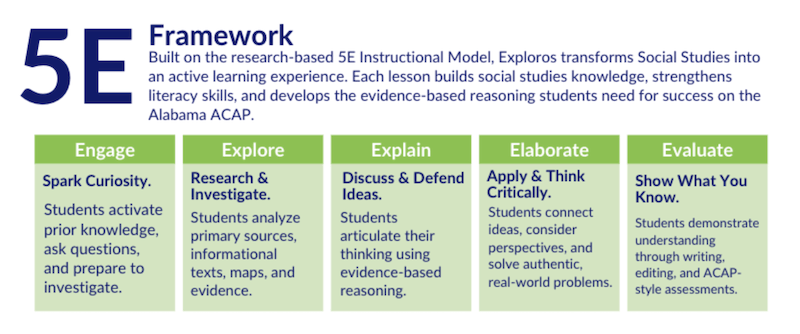
This matters because many social studies teachers value inquiry, but inquiry can feel difficult to manage. There may be concerns about time, coverage, discussion, source work, or alignment. The 5E model helps because it gives inquiry a structure. Engage creates the question or tension. Explore gives students evidence. Explain helps students consolidate accurate understanding. Elaborate extends or applies learning. Evaluate checks what students know and can do.
That structure keeps inquiry from becoming a random activity. It also keeps standards from becoming isolated coverage. A well-designed 5E lesson does not ask teachers to choose between active learning and content mastery. It sequences learning so students encounter content through a meaningful arc, building the knowledge, literacy, and reasoning they need to think deeply about the social world.
How Exploros Brings 5E Social Studies to Life
At Exploros, the 5E model is more than a framework we reference. It shapes how we design social studies experiences.
Exploros lessons are built to move students through purposeful inquiry. Students begin by activating their thinking around a question, issue, pattern, or problem. They investigate sources, maps, visuals, data, readings, media, and scenarios. They build understanding through evidence and guided sensemaking. They apply or extend learning through discussion, reflection, writing, comparison, or authentic tasks. They demonstrate understanding through aligned assessment.
That structure supports high-quality social studies because it keeps students active in the learning. It also gives teachers a clear instructional pathway. Students are not simply moving from screen to screen or task to task. They are moving through a designed learning arc.
Exploros is built around three connected principles: teacher-guided, student-centered, and device-enabled.
- Teacher-guided means technology does not replace the teacher’s role. It strengthens it. Exploros experiences include structure, pacing, prompts, instructional supports, and teacher guidance so teachers can focus on what matters most: listening to student thinking, asking better follow-up questions, clarifying misconceptions, connecting ideas, and moving the class forward.
- Student-centered means students are not passive recipients of information. They are asked to think, respond, discuss, investigate, explain, and apply. Exploros gives every student a voice, not only the students most likely to raise their hands. Through polls, walls, graphic organizers, written responses, discussions, and other interactive tasks, all students have regular opportunities to show what they are thinking. Device-enabled means technology is used in service of instruction, not as an end in itself. It is the collection point, not the end point. The platform helps make learning visible, interactive, and manageable.
- Teachers can see student responses in real time, identify patterns, surface different perspectives, and use that information to guide instruction. Students can engage with sources, maps, data, texts, images, and tasks in ways that support participation and evidence-based thinking.
These principles work together. Exploros makes teachers’ lives easier by providing ready-to-teach, standards-aligned experiences with embedded instructional design. It gives students more opportunities to participate. It helps teachers see and respond to student thinking. It supports literacy, inquiry, and evidence-based reasoning through the content itself.
This is one of the most important differences between assigning work and teaching through inquiry. When students’ thinking is visible, teachers can respond to it. They can press for evidence, clarify misunderstandings, connect student ideas, and move the class toward stronger understanding.
The result is social studies instruction that is standards-aligned, inquiry-based, interactive, teacher-guided, student-centered, and device-enabled. All of those pieces work together to bring high-quality social studies to more classrooms.
5E Is Flexible, Not Formulaic
One misconception about 5E is that every lesson must follow the exact same pattern in the exact same way. In practice, strong 5E design is more flexible than that.
Social studies topics vary. Some require background knowledge before students can analyze complex sources. Some work best when students begin with a pattern and develop a larger principle. Some require comparing regions, perspectives, time periods, or systems. Some move from broad historical context to a personal narrative or case study. Some ask students to apply a concept to a new civic or economic problem.
Exploros uses 5E as a flexible inquiry architecture. The model creates consistency, but it does not flatten every lesson into the same routine. Social studies teachers need lessons that are structured enough to support standards and instruction, but flexible enough to honor the complexity of the discipline.
The goal is not to make every lesson look identical. The goal is to make every lesson move students toward deeper understanding.
What 5E Means for Teachers and Administrators
For teachers, the 5E model provides a practical instructional rhythm. It helps answer important planning questions: How will I activate student thinking? What evidence or content will students investigate? When will students clarify concepts and vocabulary? How will they apply or extend what they learn? How will I know what they understand?
That rhythm can make social studies instruction more purposeful and manageable. It can also help teachers protect the deeper goals of the discipline. Instead of feeling forced to choose between covering content and creating meaningful learning experiences, teachers can use 5E to organize content in a way that leads to thinking.
For administrators, 5E offers a clear signal of instructional quality. It supports standards alignment, inquiry-based learning, student engagement, literacy development, formative assessment, classroom discourse, and evidence-based reasoning. It also makes instruction more visible. In a 5E social studies classroom, students are not only listening. They are reading, analyzing, discussing, responding, explaining, and applying. Teachers are not only delivering content. They are guiding students through an intentional learning arc.
That is the kind of social studies instruction students need.
Social Studies Should Help Students Understand the World
Social studies is about more than remembering the past or naming institutions on a chart. It helps students understand how people live together, how places shape communities, how power works, how decisions are made, how economies function, how cultures develop, how conflicts unfold, and how citizens participate in public life.
That kind of understanding cannot be built through memorization alone. Students need to investigate. They need to ask questions. They need to work with evidence. They need to compare perspectives. They need to explain ideas. They need to apply learning to new situations. They need to practice the habits of informed, thoughtful participation.
The 5E model gives social studies teachers a powerful way to make that happen. It honors standards by giving them a meaningful role in the learning process. It honors inquiry by making it practical and teachable. It honors rigor by moving students beyond knowing and doing toward thinking and learning.
Exploros brings that model to life through interactive, evidence-rich experiences that help students build knowledge, literacy, reasoning, and civic understanding.
When social studies is taught through 5E, students do more than learn what happened or how systems work. They learn to think with evidence, make meaning from complexity, and connect what they study to the world around them.
About the Author: Chris Olsen, is the Director of Curriculum for Exploros who is dedicated to transforming learning environments by empowering educators, administrators, and organizations with inquiry-based and culturally responsive strategies. Chris has years of experience in curriculum development, instructional leadership, and professional development, and specializes in inquiry-based learning that transforms schools.