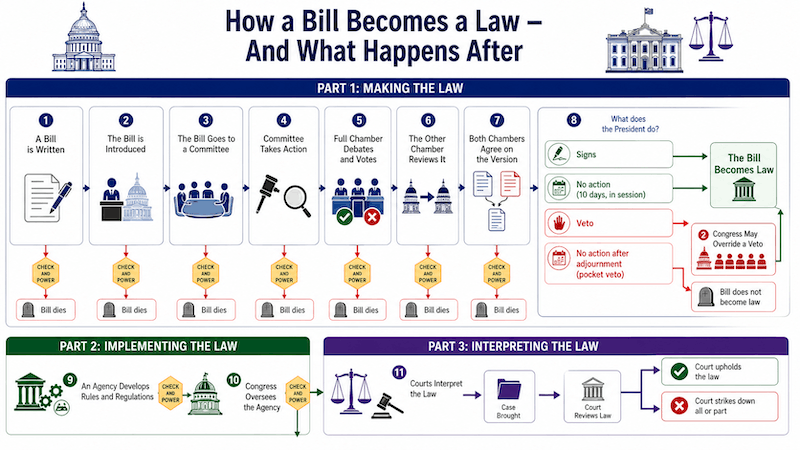
Step 1: A proposed law, called a bill, is written.
Any member of Congress, whether a member of the Senate or House of Representatives, can write a bill. The ideas for bills may come from the Congress members themselves. They may come from “the people” or from advocacy groups.
Step 2: The bill is introduced
Once the bill is written it is introduced. The person introducing the bill is called the sponsor. Other members of Congress who want the bill to be passed are called “co-sponsors.” If a Representative is the sponsor, the bill is introduced in the House. If a Senator is the sponsor, the bill is introduced in the Senate. Bills that raise taxes can only be introduced in the House. All bills introduced in Congress are given a number (H.R. 1, for example, for a bill introduced in the House, S. 1 for a bill introduced in the Senate.
Step 3: The bill is assigned to a committee
When a bill is introduced, it is assigned to a committee. Both the House and Senate have committees, smaller groups of members who are particularly interested in different topics such as health or agriculture or immigration.
Step 4: The committee takes action
Committees carefully study bills. They may hold hearings on bills to find out what experts and members of the public think. They may send the bill to an even smaller group, called a subcommittee, for further study. Committees then make changes to the bill; this is called “marking up” the bill. A committee may vote a bill out for floor action, kill the bill, or take no action (effectively letting the bill die).
Step 5: The full chamber debates and votes on the billOnce the bill reaches the floor, there is additional debate. Amendments may be proposed and voted on. The bill is then passed or defeated by the members voting.
Step 6: The bill is sent to the other chamberWhen the House or Senate passes a bill, it is referred to the other chamber. There, it goes through basically the same process as it did in the chamber where it started. This chamber may approve the bill as received, reject it, ignore it, or change it.
Step 7: The two chambers agree on one version of the bill
If the second chamber amended the bill, they may send it back to the chamber where the bill started. If that chamber doesn’t like the amended version of the bill, Congress may form a conference committee. The conference committee has members of both the House and Senate. Its job is to resolve the differences between the House and Senate versions of a bill. If the conference committee is unable to reach an agreement, the bill dies. If an agreement is reached, the committee members prepare a conference report with recommendations for the final bill. Both the House and Senate must vote to approve the conference report.
Step 8: The bill goes to the presidentAfter both the House and Senate have approved a bill in identical form, the bill is sent to the President. If the President approves of the legislation, it is signed and becomes law. If the President does not want the bill to become law, he/she can veto it. If the President takes no action for ten days while Congress is in session, the bill automatically becomes law. If no action is taken for 10 days and Congress has already adjourned, that is called a "pocket veto.”
Step 9: Congress may override the vetoIf the President vetoes a bill, Congress may attempt to override the veto. If both the Senate and the House pass the bill by a two-thirds majority, the President's veto is overruled. The bill becomes a law.
Once a bill has been passed and signed into law, a lot of work remains to be done before the law can be effective. Congress cannot provide all the details that are needed to make the law workable. That job goes to the executive branch.
Step 10: An agency develops rules and regulations
In the bill, Congress says which agency should be in charge of putting the law into action. The signed law goes to that agency. They develop rules and regulations for implementing the law. For example, if Congress passes a law allocating money for dropout prevention, the law would go to the U.S. Department of Education. The Department would develop rules and regulations for putting the law in action. For example, they would say who can get the money, how they can get it, and what kinds of activities they can pay for with the money. The public is given a chance to comment on the rules and regulations. They are then revised and put in place. These rules and regulations have the force of law.
Step 11: Congress oversees the agency’s work
Congress has the responsibility to make sure the executive branch is working as it should. It provides oversight of what agencies are doing to implement the laws Congress passed.
Step 12: Interpreting the law
The courts cannot rule on whether a law is constitutional or not unless someone brings a case. This means the Supreme Court cannot just look at a new law and say “That law violates the First Amendment” and strike the law down. Someone has to sue, claiming that their rights were violated. Then the courts can make a ruling. This is called judicial review. The courts can strike down all, part, or none of a law that is challenged.