Article II of the U.S. Constitution establishes the executive branch. It creates the presidency, outlines broad responsibilities such as enforcing laws and commanding the military, and names several specific powers, including vetoing legislation and appointing officials with Senate approval. Compared with Article I, which carefully details the structure and powers of Congress, Article II is brief and general.
That brevity created a practical challenge from the beginning. The Constitution grants the president “executive power,” but it does not describe in detail the offices, departments, or administrative systems needed to carry out federal law in a large and growing nation. Over time, the United States built a complex network of executive institutions—often called the federal bureaucracy—to make national governance possible. The development of these institutions was not accidental. It reflected ongoing decisions about how to balance efficiency, expertise, and accountability in a constitutional democracy.

The First Cabinet: A Practical Solution to a Constitutional Gap
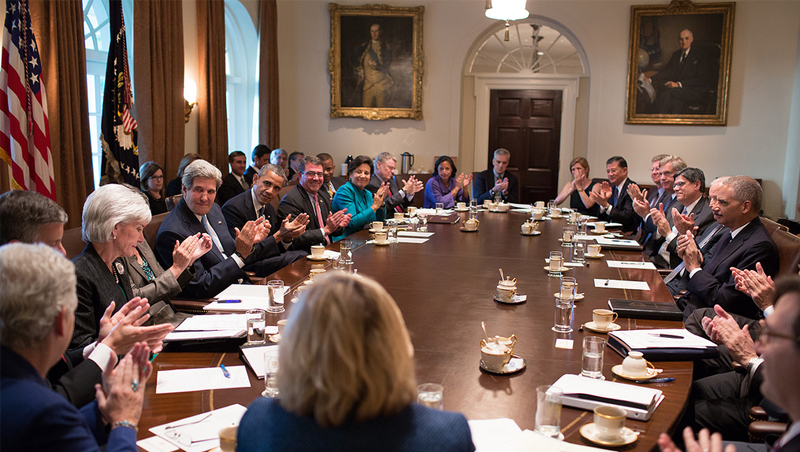
When the new federal government began operating in 1789, the nation was small, its institutions were untested, and its administrative needs were limited. The Constitution had created a president but had not listed executive departments or described a Cabinet. Still, President George Washington quickly realized that he needed assistance from trusted advisers who could manage specialized areas of governance.
Congress responded by creating the first executive departments. These included the Department of State, responsible for foreign affairs; the Department of the Treasury, responsible for national finances; and the Department of War, responsible for military affairs. The Office of the Attorney General was also established to provide legal advice and represent the government in court. Washington began meeting regularly with the heads of these departments. Over time, this group of advisers became known as the Cabinet.
The Cabinet was not explicitly required by the Constitution. Instead, it developed through law, precedent, and practical necessity. From the earliest years of the republic, executive structure evolved in response to the demands of governing rather than detailed constitutional instructions. This pattern—constitutional framework followed by institutional development—would continue as the country expanded.
Expansion in the Nineteenth Century
As the United States grew geographically and economically during the nineteenth century, federal responsibilities expanded. Westward expansion, the management of public lands, relations with Native nations, industrial growth, and national communication systems all required administrative coordination.
The Post Office became one of the largest and most important federal institutions of the era because commerce and communication depended on it. Railroads and industrialization introduced new economic challenges that required national oversight. Although the federal government remained smaller than it is today, the trend was clear: as the scope of national life expanded, executive administration expanded as well.
The Twentieth Century and the Rise of Modern Administration
The most dramatic growth in the executive branch occurred in the twentieth century, particularly during the Great Depression and World War II. These crises reshaped public expectations of what the federal government should do.
During the Great Depression, economic collapse led Congress to pass numerous laws aimed at relief, recovery, and reform. Implementing these programs required new agencies, offices, and regulatory bodies. Laws alone could not solve economic problems; administrative institutions were needed to carry them out. The executive branch expanded not simply because presidents sought more authority, but because Congress created structures to administer complex national programs.
World War II and the Cold War further increased federal responsibilities. Permanent national defense planning, intelligence gathering, and global diplomacy required stable and specialized institutions. By the late twentieth century, federal responsibilities extended into environmental protection, workplace safety, food and drug regulation, financial oversight, disaster response, public health coordination, and civil rights enforcement.
In a complex and interconnected society, governance required expertise, continuity, and administrative capacity. Yet this expansion also intensified a central constitutional tension. If the executive branch must be large enough to function effectively, how can it remain accountable in a system grounded in popular sovereignty?
The Federal Bureaucracy: Structure and Daily Governance
The term bureaucracy refers to the institutions and employees responsible for carrying out the daily work of government. In the federal executive branch, it includes millions of employees and thousands of offices that implement laws, manage programs, and enforce regulations.
The federal bureaucracy is not a single unified entity. It consists of multiple types of agencies designed with different leadership structures and levels of independence. These structural differences matter because they shape who directs policy, how decisions are made, and how accountable those decisions are to elected leadership and the public.
Cabinet Departments

Cabinet departments are major executive organizations led by secretaries or, in the case of the Department of Justice, the attorney general. These leaders are appointed by the president and confirmed by the Senate. Cabinet departments represent the most direct extension of presidential administration.
They are characterized by:
leadership closely tied to the president
hierarchical organization with clear lines of authority
responsibility for broad policy areas such as defense, education, health, and foreign affairs
Because Cabinet leaders generally serve at the president’s pleasure, they can often be replaced when administrations change. This structure promotes political responsiveness and allows presidents to pursue policy agendas within large administrative departments. At the same time, it keeps executive authority visibly connected to elected leadership.
Independent Executive Agencies
Independent executive agencies operate within the executive branch but are not housed inside Cabinet departments. They often focus on specialized missions that require technical expertise or consistent oversight across administrations.
Examples include NASA, the Environmental Protection Agency, and the Social Security Administration. Leaders of these agencies are typically appointed by the president and confirmed by the Senate, but their design may provide some insulation from direct political pressure, depending on the agency’s mission and statutory structure.
Congress may choose this structure when it seeks a balance between executive supervision and professional expertise. Independent executive agencies remain part of the president’s broader authority but may operate with greater operational focus in specific policy areas.

Independent Regulatory Commissions
Independent regulatory commissions are designed to regulate complex sectors of the economy or protect public interests in areas such as finance, communications, or labor relations. Unlike Cabinet departments, they are usually led by multi-member commissions or boards rather than a single director.
Their structural features often include:
commissioners appointed by the president and confirmed by the Senate
staggered terms to prevent all members from being replaced at once
legal protections that limit removal in certain circumstances
This design aims to promote stability, continuity, and decision-making based on expertise rather than immediate political shifts. Congress may create such commissions when it wants to reduce the likelihood that regulatory policy will change dramatically with each election. However, this insulation from direct presidential control can also raise questions about democratic accountability.
Government Corporations
Government corporations are agencies that provide services in a business-like manner while serving public purposes. Examples include the U.S. Postal Service and Amtrak.
These entities often have boards of directors, operational flexibility, and independent budgets. They are designed to deliver services efficiently at a national scale while remaining publicly accountable through congressional oversight and statutory requirements.
Congress may adopt this model when it seeks a structure that combines public goals with administrative flexibility. Government corporations illustrate yet another way in which institutional design attempts to balance efficiency and public control.
Why Multiple Structures Exist
The existence of multiple types of executive agencies reflects the complexity of modern governance. Different policy areas require different forms of leadership, expertise, stability, and responsiveness. Structural choices represent attempts to balance competing goals:
responsiveness to elected leadership
professional expertise
policy stability
clear lines of authority
public accountability
Congress and presidents have repeatedly faced the same fundamental question: how should power be organized so that government can function effectively without drifting too far from democratic control?
Understanding the development and structure of the federal bureaucracy provides the background necessary to examine how specific executive departments operate—and how their design shapes both governance and accountability.