
Source 1: Reconstruction and Racial Violence
After the Civil War ended, many Americans hoped that freedom and new laws would create peace in the South. But instead, the years after the war were filled with racial violence. Some white Southerners, angry about the changes, used threats and attacks to try to keep Black people from voting, owning land, or gaining power. These violent acts spread across the South and became one of the most serious backlashes to Reconstruction.
Groups like the Ku Klux Klan formed to stop Black progress. The Klan began in Tennessee in 1866 and quickly spread to almost every Southern state. Members wore disguises and rode at night to attack people they saw as supporters of Reconstruction. They beat, whipped, and sometimes killed Black men and women who tried to vote or hold office. They also targeted white Southerners who worked with the Republican Party. These people were called “scalawags” by their enemies.
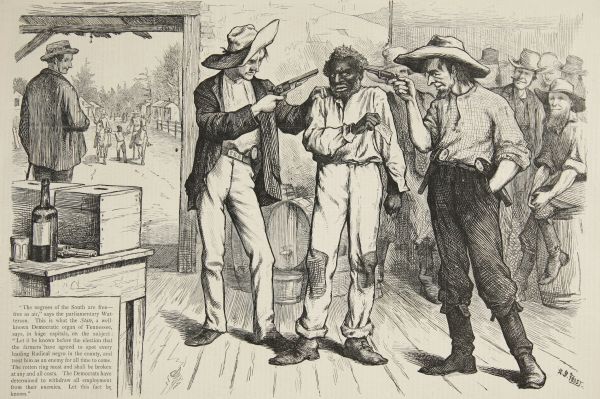
The Klan and other groups, like the White League and the Knights of the White Camelia, tried to control elections. They often surrounded polling places, forcing Black voters to stay home. In one county in Georgia, hundreds of people who voted Republican in the spring were too afraid to do so by the fall. The violence worked. White Democrats soon regained power in many states.
Lynchings also became common during Reconstruction. A lynching is a killing carried out by a mob, usually without a trial. Black people were targeted for voting, holding office, owning land, or simply challenging white authority. Law enforcement often did nothing to stop these attacks. Historians estimate that thousands of African Americans were lynched in the South during and after Reconstruction, with some states seeing hundreds of victims. Lynching was used to spread fear and control Black communities.
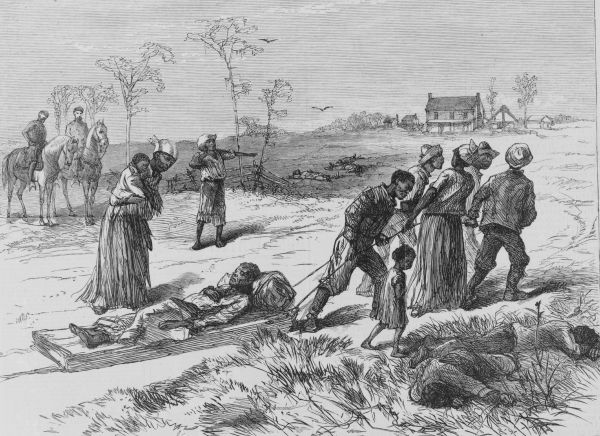
Some of the worst attacks were often called massacres. In 1868 in Opelousas, Louisiana, white mobs killed around 250 Black people after a political dispute. In 1873, in Colfax, Louisiana, a similar attack left more than 100 Black men dead. These events showed that the goal of the attackers was not only to win elections but also to destroy Black communities.
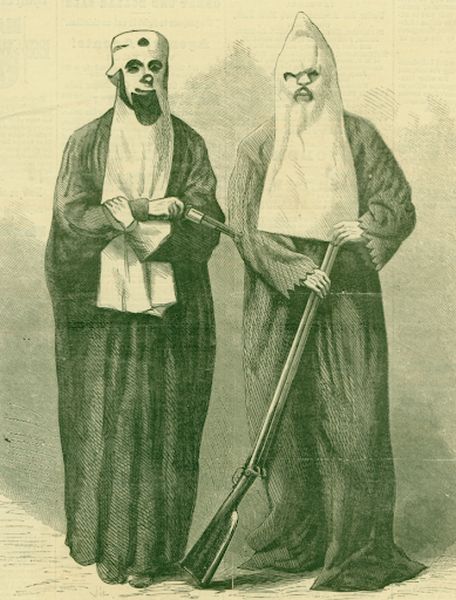
Violence also happened for small reasons. A Black man might be attacked for refusing to step off a sidewalk or for asking to be paid for his work. Women and children were not safe either. Families were sometimes killed in their homes or driven into the woods to hide.
President Ulysses S. Grant and Congress tried to fight back. Between 1870 and 1871, they passed laws called the Enforcement Acts to stop Klan violence. These laws made it a federal crime to keep people from voting. They also allowed the president to send soldiers to arrest Klan members. For a short time, the violence slowed down. But by the middle of the 1870s, national attention had shifted away from the South.
By the end of Reconstruction in 1877, many white Southerners had regained political control. The violence of the previous years had succeeded in weakening Black political power. Thousands of people had been killed or terrorized. Racial violence became a tool that helped end Reconstruction and shaped the unequal system that followed.
Source 2: The Louisiana Murders—Gathering The Dead And Wounded by Charles Harvey Weigall (1873)
Context: This image was published in Harper's Weekly on May 10, 1873, after the Colfax massacre in Colfax, Louisiana, on April 13, 1873.
Source 3: Abram Colby, Testimony before Congress, 1872
Context: This excerpt is from the 1872 testimony of Abram Colby, a formerly enslaved man who served in the Georgia state legislature during Reconstruction. Colby testified before Congress about his experiences in Georgia and the actions of the Ku Klux Klan during that time.
Excerpt:
Colby: On the 29th of October 1869, [the Klansmen] broke my door open, took me out of bed, took me to the woods and whipped me three hours or more and left me for dead. They said to me, "Do you think you will ever vote another damned Radical ticket?" I said, "If there was an election tomorrow, I would vote the Radical ticket." They set in and whipped me a thousand licks more, with sticks and straps that had buckles on the ends of them.
Question: What is the character of those men who were engaged in whipping you?
Colby: Some are first-class men in our town. One is a lawyer, one a doctor, and some are farmers. They had their pistols and they took me in my night-clothes and carried me from home. They hit me five thousand blows. I told President Grant the same that I tell you now. They told me to take off my shirt. I said, "I never do that for any man." My drawers fell down about my feet and they took hold of them and tripped me up. Then they pulled my shirt up over my head. They said I had voted for Grant and had carried the Negroes against them. About two days before they whipped me they offered me $5,000 to go with them and said they would pay me $2,500 in cash if I would let another man go to the legislature in my place. I told them that I would not do it if they would give me all the county was worth.
The worst thing was my mother, wife and daughter were in the room when they came. My little daughter begged them not to carry me away. They drew up a gun and actually frightened her to death. She never got over it until she died. That was the part that grieves me the most.
Question: How long before you recovered from the effects of this treatment?
Colby: I have never got over it yet. They broke something inside of me. I cannot do any work now, though I always made my living before in the barber-shop, hauling wood, etc.
Question: You spoke about being elected to the next legislature?
Colby: Yes, sir, but they run me off during the election. They swore they would kill me if I stayed. The Saturday night before the election I went to church. When I got home they just peppered the house with shot and bullets.
,_Harper%27s_Weekly.jpg)
