
Source 1: Reconstruction and Legal Suppression
After the Civil War, slavery ended, but freedom did not mean equality. Southern states quickly passed new laws to control the lives of Black Americans. These laws changed how people could work, move, vote, and live. Many of them were designed to limit Black freedom during Reconstruction and to weaken Black political power as Reconstruction came to an end.
In 1865 and 1866, Southern states passed laws called Black Codes. These laws applied only to Black people. They limited where Black people could live, the jobs they could hold, and how they could earn money. Many Black Codes required Black workers to sign labor contracts with white employers. Leaving a job early could lead to arrest or punishment. Some laws also banned Black people from owning firearms or traveling without written permission.
Vagrancy laws were another tool used to control Black lives. Under these laws, a person could be arrested for being unemployed or homeless. Many newly freed people were arrested while searching for work or family members. Courts could then force them to work without pay. In some states, people accused of vagrancy were made to wear chains or hired out to private employers.
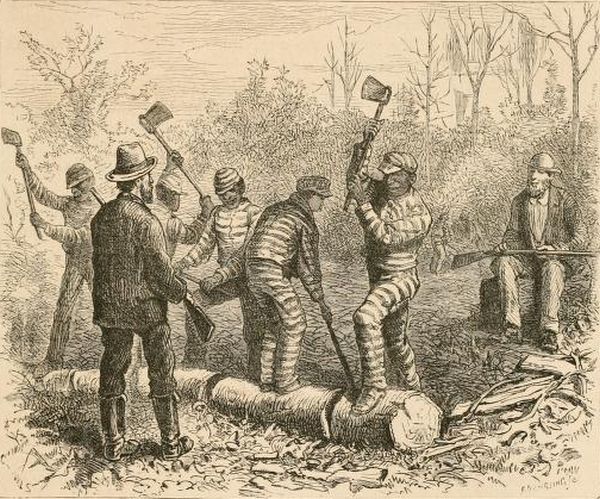
Southern states also used the criminal justice system to continue forced labor. The Thirteenth Amendment ended slavery, except as punishment for a crime. States arrested Black people for minor offenses and leased them to private companies. This system was called convict leasing. Prisoners were sent to farms, mines, railroads, and factories. Conditions were dangerous, and many people died while working.
As Reconstruction weakened, Southern lawmakers passed new voting laws. These laws made it difficult for Black citizens to vote, even though the Fifteenth Amendment protected voting rights. Poll taxes required people to pay money to vote. Literacy tests required voters to read or explain parts of the law. Grandfather clauses allowed white voters to avoid these rules if their ancestors had voted before the war. These laws sharply reduced Black voter registration.
Southern states also passed segregation laws, later called Jim Crow laws. These laws required Black and white people to use separate public spaces. Schools, trains, parks, hospitals, and even drinking fountains were divided by race. Some cities passed curfew laws that restricted when Black people could be outside at night. These laws shaped daily life and enforced racial separation.
By 1877, federal troops were withdrawn from the South. White lawmakers regained control of state governments. Many of the laws passed during and after Reconstruction remained in place for decades. Together, these changing laws limited Black freedom and reshaped Southern society.
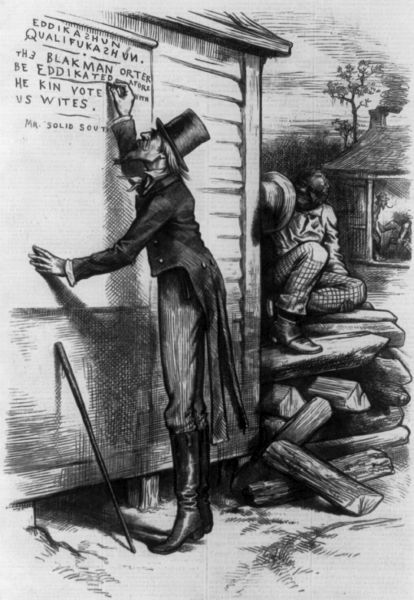
Source 2: The Solid South by Thomas Nast (1876)
Context: This political cartoon was published in Harper’s Weekly on November 11, 1876.
Source 3: James T. Rapier and Alonzo J. Ransier, Speeches on the Civil Rights Bill, June 9, 1874
Context: This excerpt is from speeches delivered in the U.S. House of Representatives on June 9, 1874. The remarks were part of a congressional debate over the Civil Rights Bill that was later passed in 1875.
Excerpt:
Sir, there is a cowardly propensity in the human heart that delights in oppressing somebody else, and in the gratification of this base desire we always select a victim that can be outraged with safety. As a general thing the Jew has been the subject in most parts of the world;; but here the negro is the most available for this purpose;; for this reason in part he was seized upon, and not because he is naturally inferior to any one else. Instead of his enemies believing him to be incapable of a high order of mental culture, they have shown that they believe the reverse to be true, by taking the most elaborate pains to prevent his development. And the smaller the caliber of the white man the more frantically has he fought to prevent the intellectual and moral progress of the negro, for the simple but good reason that he has most to fear from such a result. He does not wish to see the negro approach the high moral standard of a man and gentleman
Let me call your attention to a case in point. Some time since a well dressed colored man was traveling from Augusta to Montgomery. The train on which he was stopped at a dinner-house. The crowd around the depot seeing him well dressed, fine-looking, and polite, concluded he must be a gentleman, (which was more than their righteous souls could stand,) and straightway they commenced to abuse him. And, sir, he had to go into the baggage-car, open his trunks, show his cards, faro-bank, dice, & c., before they would give him any peace;; or, in other words, he was forced to give satisfactory evidence that he was not a man who was working to elevate the moral and intellectual standard of the negro before they would respect him. I have always found more prejudice existing in the breasts of men who have feeble minds and are conscious of it, than in the breasts of those who have towering intellects and are aware of it. Henry Ward Beecher reflected the feelings of the latter class when on a certain occasion he said: "Turn the negro loose;; I am not afraid to run the race of life with him." He could afford to say this, all white men cannot;; but what does the other class say? "Build a Chinese wall between the negro and the school-house, discourage in him pride of character and honest ambition, cut him off from every avenue that leads to the higher grounds of intelligence and usefulness, and then challenge him to a contest upon the highway of life to decide the question of superiority of race." By their acts, not by their words, the civilized world can and will judge how honest my opponents are in their declarations that I am naturally inferior to them. No one is surprised that this class opposes the passage of the civil-rights bill, for if the negro were allowed the same opportunities, the same right of locomotion, the same rights to comfort in travel, how could they prove themselves better than the negro?
