
Source 1: The Political Response to Reconstruction
During Reconstruction, government responses to change varied at the local, state, and national levels. In many Southern communities, local government became a major source of conflict. Newly freed Black men were elected as sheriffs, magistrates, constables, and election officials. These officials helped protect voting rights and resolve disputes. Their presence changed daily life for many Black families. Many white residents reacted with anger to Black officials holding authority close to home. Threats, violence, and intimidation became common. These actions were meant to block Black political power and maintain control.
State governments also played an important role during Reconstruction. New state constitutions gave Black men the right to vote and hold office, and Republican legislatures passed civil rights laws and created public school systems. In several states, Black lawmakers made up a large share of the legislature. They helped shape laws and policies. Some white Southerners supported Reconstruction and worked with Black lawmakers in Republican governments. Their opponents called these men “scalawags,” a derogatory term meant to label them as traitors to the South.
Governors gained new powers and controlled state militias, and some used these militias to fight violent groups like the Ku Klux Klan. Arkansas Governor Powell Clayton declared martial law. He ordered the militia to arrest Klan members. As a result, violence slowed for a brief period. State governments faced strong resistance from white voters. Many opponents pointed to higher taxes and accused Republican leaders of corruption. These claims were used to turn public opinion against Reconstruction policies.
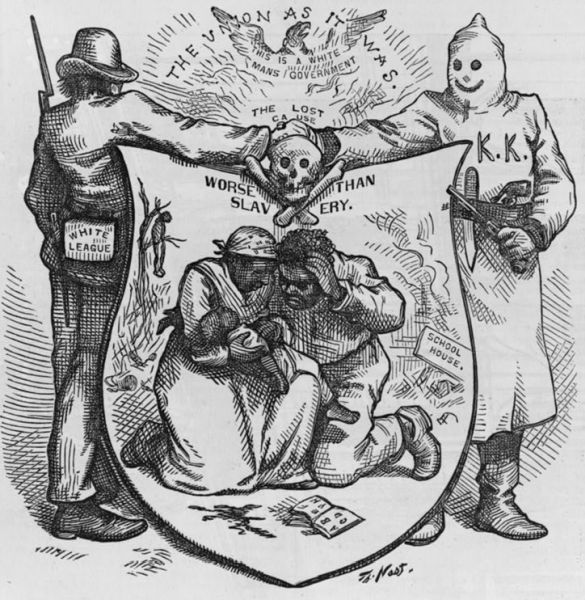
As white Democrats regained control of state governments, many Reconstruction policies were reversed. Legislatures rewrote state constitutions and limited the power of voters and local officials. These changes focused on areas with large Black populations. Some states removed the right to elect judges and returned that power to lawmakers. These actions reduced Black political influence. They also made it easier for white leaders to control elections. By the mid-1870s, many state governments no longer worked to protect Black rights.
The national government took the strongest actions during the early years of Reconstruction. Congress passed the Civil Rights Act of 1866 and approved the Fourteenth and Fifteenth Amendments. These laws defined citizenship and protected voting rights. Federal troops were stationed in the South under the Reconstruction Acts. Military districts helped enforce new laws and support elections. Congress also passed the Enforcement Acts. These laws made it a federal crime to interfere with voting and allowed the arrest of Klan members. Federal investigations gathered testimony about violence, and marshals sometimes made arrests.
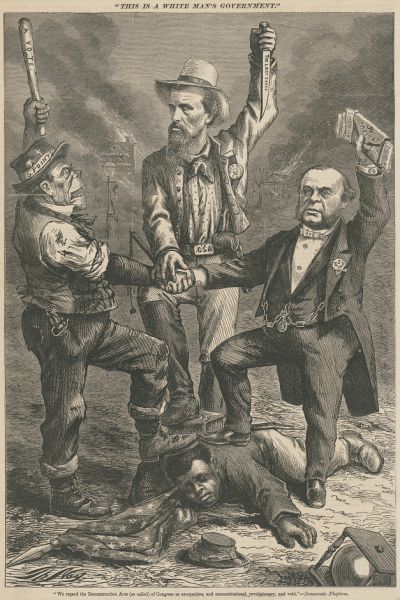
Over time, national support weakened as political priorities shifted and elections became more contested. Efforts to pass stronger election laws failed. Enforcement of existing laws declined. After the disputed presidential election of 1876, federal troops were withdrawn from the South. Federal involvement in protecting Black citizens decreased. By 1877, Reconstruction ended, and government responses at all levels moved away from defending Black civil and political rights.
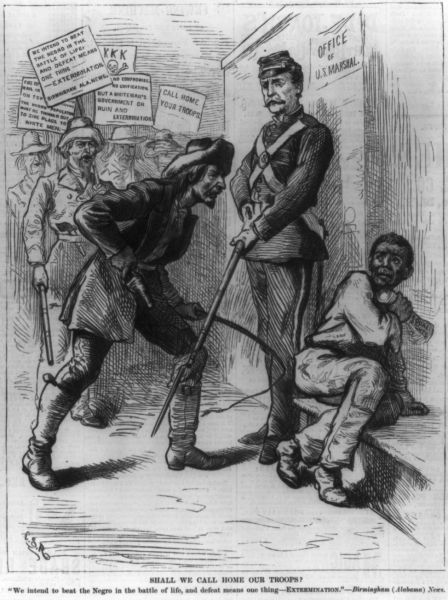
Source 2: Shall we call home our troops by Thomas Nast (1874)
Context: This political cartoon was drawn by Thomas Nast and published in Harper’s Weekly in 1874. The caption reads, “Shall we call home our troops? ‘We intend to beat the Negro in the battle of life, and defeat means one thing—extermination.’”
Source 3: Martin W. Gary's Plan for the Conservative Campaign of 1876
Context: Martin W. Gary was a former Confederate General and South Carolina politician who authored this "Plan of the Campaign" in 1876. He wrote these specific instructions as a strategic memo for the Red Shirts, an armed paramilitary organization, to follow during the state's 1876 election cycle.
Excerpt:
Every Democratic must feel honor bound to control the vote of at least one Negro, by intimidation, purchase, keeping him away or as each individual may determine, how he may best accomplish it.
We must attend every Radical meeting that we hear of whether they meet at night or in the day time. Democrats must go in as large numbers as they can get together, and well armed, behave at first with great courtesy and assure the ignorant Negroes that you mean them no harm and so soon as their leaders or speakers begin to speak and make false statements of facts, tell them then and there to their faces, that they are liars, thieves and rascals, and are only trying to mislead the ignorant Negroes and if you get a chance get upon the platform and address the Negroes.
In speeches to Negroes you must remember that argument has no effect upon them: they can only be influenced by their fears, superstitions and cupidity... Prove to them that we can carry the election without them and if they co-operate with us, it will benefit them more than it will us. Treat them so as to show them...that their natural position is that of subordination to the white man…
In the month of September we ought to begin to organize Negro clubs, or pretend that we have organized them and write letters from different parts of the County giving the facts of organization [but] from prudential reasons, the names of the Negroes are to be withheld. Those who join us are to be taken on probation and are not to be taken into full fellowship, until they have proven their sincerity by voting our ticket…
In all processions the clubs must parade with banners, mottoes, etc. and keep together so as to make an imposing spectacle.
_News_LCCN2002737343.jpg)