
Snapshot 1: Brady v. Maryland (1958–1963)
In 1958, John Brady and Charles Boblit were convicted of murder and sentenced to death. Brady admitted involvement in the crime but argued that Boblit committed the actual killing. Before the trial, Boblit had confessed in a statement, but prosecutors did not share that evidence with Brady’s defense. After his conviction, Brady learned about the withheld confession and argued that this violated his right to a fair trial.
The courts agreed that suppressing evidence favorable to the accused violated due process. The U.S. Supreme Court ruled that when prosecutors withhold material evidence that could affect guilt or punishment, it undermines the fairness of the trial—even if it was not done intentionally. This decision established what became known as the “Brady Rule,” requiring prosecutors to disclose such evidence to the defense.
______________________________________________________________________
Snapshot 2: Central Park Jogger Case / Central Park Five (1989–2002)
In 1989, a woman was brutally attacked in New York City’s Central Park. Police arrested five Black and Latino teenagers and obtained confessions after hours of interrogation. These confessions included inconsistencies and were later recanted, and no DNA evidence linked the boys to the crime. Despite this, all five were convicted and served years in prison.
In 2002, another man, Matias Reyes, confessed to the attack, and DNA evidence confirmed he acted alone. The convictions of the five teenagers were overturned. The case drew attention to how confessions were obtained, the role of evidence, and how investigations and public pressure influenced the outcome. The city later reached a financial settlement with the men after their exoneration.
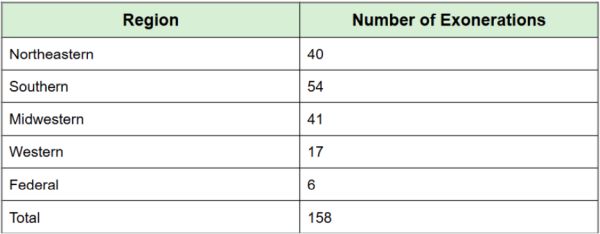
Table: Number of Exonerations by DNA Evidence in the United States (1989 to 2020)
______________________________________________________________________
Snapshot 3: Stop-and-Frisk and Floyd v. City of New York (1990s–2014)
Stop-and-frisk is a policing practice used by the New York Police Department in which officers stop individuals based on suspicion and may search them. The case Floyd v. City of New York was brought by several plaintiffs representing thousands of New Yorkers, many of whom were Black and Latino, who were stopped without clear cause while going about everyday activities like walking home or going to work or school.
The lawsuit argued that these stops often lacked reasonable suspicion and disproportionately targeted Black and Latino residents. Data showed that about 85 percent of those stopped were Black and Latino, even though they made up a smaller share of the city’s population. In 2013, after a nine-week trial, a federal judge ruled that the NYPD had engaged in a pattern of unconstitutional stops and racial profiling, violating both the Fourth Amendment and the Equal Protection Clause of the Fourteenth Amendment.
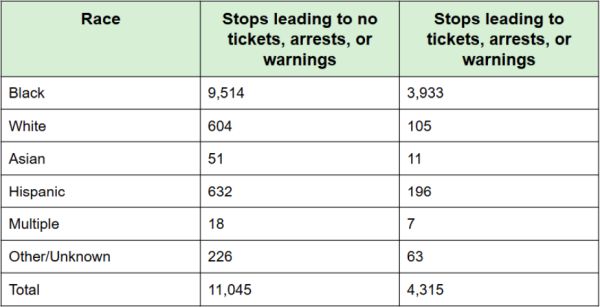
Table: Number of Stop-and-Frisk Stops in the D.C. Metropolitan Area in 2020
______________________________________________________________________
Snapshot 4: Guantánamo Bay and Hamdi v. Rumsfeld (2001–2004)
After the September 11, 2001 attacks, Congress passed the Authorization for Use of Military Force (AUMF), giving the president the power to act against individuals and groups connected to the attacks. As part of this response, the United States detained people suspected of supporting or fighting with enemy forces. Some were held at Guantánamo Bay, a U.S. military base in Cuba, beginning in 2002.
Yaser Esam Hamdi, who was born in the United States, was captured in Afghanistan in 2001 and detained by the U.S. military as an “enemy combatant.” He was held without formal charges and initially without access to a lawyer. The government argued that it had the authority to detain him during wartime, while his father challenged the detention, claiming it violated his constitutional rights.
In 2004, the Supreme Court ruled that although the government can detain enemy combatants, a U.S. citizen must be given a meaningful opportunity to challenge that detention. The Court held that due process requires notice of the reasons for detention and a chance to respond before a neutral decision-maker.
______________________________________________________________________
Snapshot 5: Texas Department of Transportation v. Self (2024)
In this case, the Texas Department of Transportation (TxDOT) directed contractors to clear trees along a roadway. As a result, trees on private property—outside the state’s legal right-of-way—were removed. The property owners argued that the government had effectively taken or destroyed their property.
TxDOT claimed it could not be sued because it did not intend to take private property and was protected by sovereign immunity. However, the Texas Supreme Court ruled that the property owners could proceed with their claim. The court explained that when the government intentionally destroys or takes property for public use, it may be required to provide compensation—even if it mistakenly believed it had the right to do so.