
When Hernán Cortés arrived on the coast of Mexico in A.D. 1519, the Aztec Empire was one of the most powerful states in Mesoamerica. Its capital, Tenochtitlan, was a large city with hundreds of thousands of people, busy markets, temples, canals, and causeways.
Yet only two years later, Tenochtitlan had fallen. The Spanish conquest succeeded because of several factors working together. Spanish weapons played a role, but Indigenous alliances, epidemic disease, and the siege of the capital were also extremely important.
Weapons and Warfare
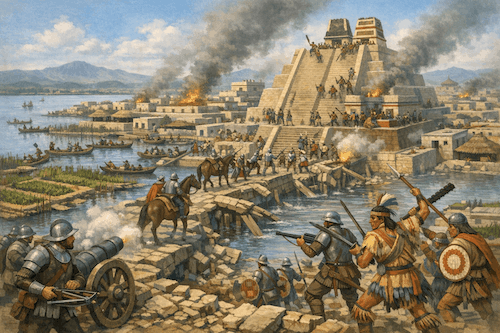
Spanish soldiers brought military technologies that were unfamiliar to the Aztec, including steel swords and armor, firearms, cannons, and horses. These gave the Spanish some advantages, especially because horses could move soldiers quickly and could frighten people who had never encountered them before.
Aztec warriors were also skilled and well organized. They fought with weapons such as bows, spears, slings, and macuahuitls, wooden weapons fitted with sharp obsidian blades.
Spanish technology alone did not determine the outcome. Cortés arrived with only a relatively small number of Spanish soldiers, so he needed other sources of support.
Indigenous AlliancesThe Aztec Empire controlled many communities in central Mexico and required conquered peoples to provide tribute, such as food, cloth, valuable goods, and other resources. Some communities resented Aztec rule.
Cortés formed alliances with Indigenous peoples who had their own reasons for opposing the Aztec. The Tlaxcalans became especially important allies. Thousands of Indigenous warriors fought alongside the Spanish during the campaign against Tenochtitlan.
These allies greatly increased the size of Cortés's forces and provided knowledge of the region, food, transportation, and military support. The conquest therefore was not simply a conflict between Spaniards and Aztec. Many Indigenous peoples were active participants who made choices based on their own political interests.
DiseaseThe arrival of Europeans also brought diseases that had not previously circulated in the Americas. One of the most destructive was smallpox.
Because Indigenous populations had no previous exposure to smallpox, the disease spread rapidly and caused enormous loss of life. An epidemic reached Tenochtitlan in A.D. 1520 and killed many people, including leaders and warriors.
Disease weakened the city at the same time that it was facing military attacks and political conflict.
The Siege of TenochtitlanAt first, the Aztec ruler Moctezuma II allowed Cortés and his forces to enter Tenochtitlan. Relations soon became hostile, and the Spanish took Moctezuma captive. Fighting eventually forced the Spanish and their allies to leave the city.
Cortés later returned with a much larger force made up mostly of Indigenous allies. They surrounded Tenochtitlan and cut off important supplies of food and fresh water.
After months of fighting, hunger, disease, and destruction weakened the city. On August 13, A.D. 1521, Tenochtitlan fell to Spanish and allied Indigenous forces.
Why Did the Empire Fall?No single factor explains the fall of the Aztec Empire. Spanish weapons and horses gave Cortés some military advantages. Indigenous allies greatly increased his forces. Smallpox devastated the population, and the siege cut Tenochtitlan off from important resources.
Together, these factors allowed a relatively small group of Spanish conquistadors, supported by a much larger number of Indigenous allies, to defeat the Aztec Empire.