
Source 1: Changing Opinions in the North during Reconstruction
In the years after the Civil War, many Northerners slowly changed how they thought about race, reunion, and Reconstruction. Many people initially backed strong federal action to help freedpeople. They thought the war was fought for both freedom and the preservation of the Union. Over time, those beliefs weakened, and priorities shifted.
One major reason for this change was exhaustion. The war had lasted four years, and Reconstruction added another decade of conflict and political tension. Many Northerners grew tired of hearing about Southern violence and federal enforcement. They wanted peace, stability, and a return to normal life.
Economic concerns also reshaped Northern opinion. The Panic of 1873 caused business failures, unemployment, and falling wages across the North. Economic recovery became more important than enforcing civil rights in the South, and voters pressured politicians to focus on jobs and growth. As attention moved to money and industry, concern for Black Southerners faded.
Political scandals further weakened support for Reconstruction. Corruption in the Grant administration divided the Republican Party, and Democrats used these scandals to attack federal authority. Many Northerners thought Reconstruction governments were weak or corrupt. They placed blame on Southern Republicans and federal officials. These ideas made it easier to justify pulling back from enforcement.
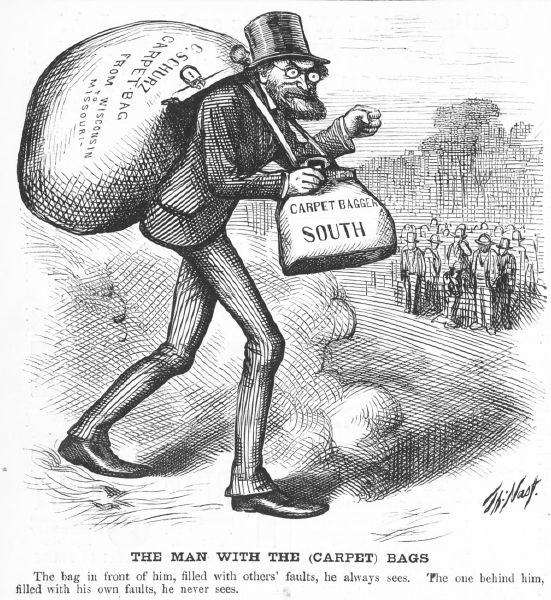
Stories about carpetbaggers also shaped opinion in the North. “Carpetbagger” was a negative term used by white Southerners to insult Northerners who moved south after the Civil War. Many of these Northerners were teachers, former Union soldiers, investors, or government workers. Over time, exaggerated claims of corruption helped weaken Northern support for Reconstruction.
Racism also played a central role in changing attitudes. Many white Northerners supported emancipation but still believed in racial hierarchy. As Black men voted, held office, and demanded equality, some Northerners grew uncomfortable. These feelings made it easier to accept claims that Reconstruction had gone too far.
Ideas about reunion helped reshape public memory of the war. Many Northerners wanted to make peace with white Southerners. They believed that unity needed forgiveness, not punishment. This desire for reunion often came at the expense of justice for formerly enslaved people. Protecting Black rights seemed less important than healing sectional divisions.
The Lost Cause narrative also influenced Northern opinion. Although it began in the South, many Northerners accepted its ideas over time. Stories that praised Confederate soldiers and minimized slavery helped soften views toward the former Confederacy. These ideas allowed Northerners to see the war as a shared tragedy instead of a moral struggle.
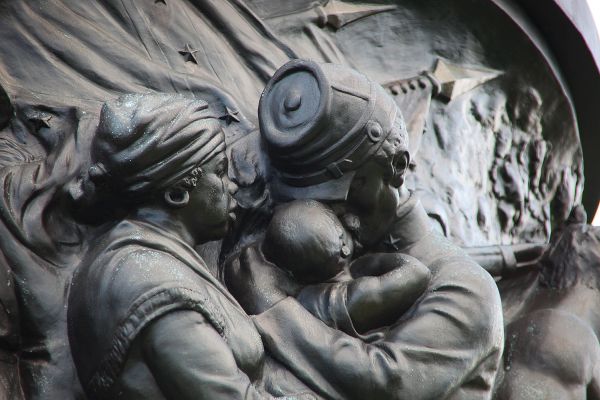
War memorials reflected these changing beliefs. Northern monuments often honored soldiers without mentioning slavery or emancipation. They emphasized bravery, sacrifice, and national unity instead. By avoiding slavery, these monuments helped erase the war’s central cause from public memory.
As monuments shifted from union to soldier themes, the meaning of the war changed. Honoring soldiers from both sides made reconciliation easier, but it also blurred moral differences. This shift supported the idea that both sides had fought honorably, even though their causes were not equal.
Over time, Northern support for strong federal action declined. Many voters believed Reconstruction had achieved its main goals, and they accepted arguments that it should end. Although Reconstruction formally ended in 1877, the change in Northern opinion had begun much earlier. These shifts helped leave Black Americans without protection and allowed inequality to grow for generations.
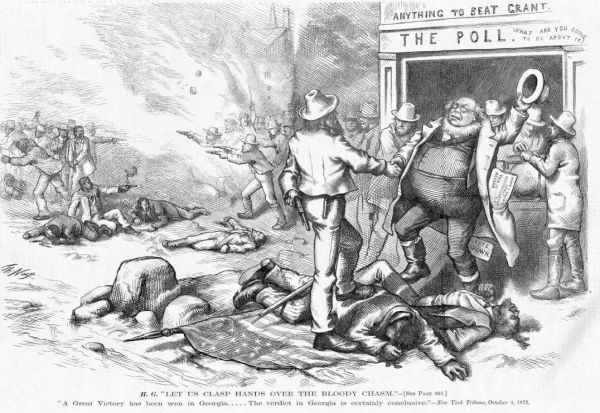
Source 2: Let us clasp hands over the bloody chasm by Thomas Nast (1872)
Context: This political cartoon was drawn by Thomas Nast and published in Harper’s Weekly in New York in 1872. It depicts figures representing Northern Democrats and white Southern politicians meeting at a polling place amid violence. The caption reads, “Let us clasp hands over the bloody chasm…A great victory has been won in Georgia… The verdict in Georgia is certainly conclusive.’—New York Tribune, October 3, 1872.”
Source 3: Excerpt from Liberal Republican Platform of 1872
Context: This document was written by members of the Liberal Republican Party at their national convention in 1872. It was presented to party delegates and the public during a period of growing political division in the North, as debates over Reconstruction, federal power, and national priorities continued after the Civil War.
Excerpt:
May 01, 1872
We, the Liberal Republicans of the United States, in National Convention assembled at Cincinnati, proclaim the following principles as essential to just government:
First: We recognize the equality of all men before the law, and hold that it is the duty of Government, in its dealings with the people, to mete out equal and exact justice to all, of whatever nativity, race, color, or persuasion, religious or political.
Second: We pledge ourselves to maintain the Union of these States, emancipation and enfranchisement, and to oppose any reopening of the questions settled by the Thirteenth, Fourteenth, and Fifteenth Amendments to the Constitution.
Third: We demand the immediate and absolute removal of all disabilities imposed on account of the Rebellion, which was finally subdued seven years ago, believing that universal amnesty will result in complete pacification in all sections of the country.
Fourth: Local self-government, with impartial suffrage, will guard the rights of all citizens more securely than any centralized power. The public welfare requires the supremacy of the civil over the military authority, and freedom of person under the protection of the habeas corpus. We demand for the individual the largest liberty consistent with public order; for the State, self-government, and for the nation a return to the methods of peace and the constitutional limitations of power.


