
The Mexica, often called the Aztec, practiced a religion with many gods connected to forces of nature, agriculture, warfare, and everyday life. Huitzilopochtli was one of their most important gods and was associated with the sun and war.
Religious ceremonies were an important part of Aztec life. Some ceremonies included human sacrifice, which the Aztec believed helped maintain relationships between humans and the gods and kept the natural and spiritual world in balance. The number of people sacrificed is debated by historians, but sacrifice was an important part of some religious rituals.
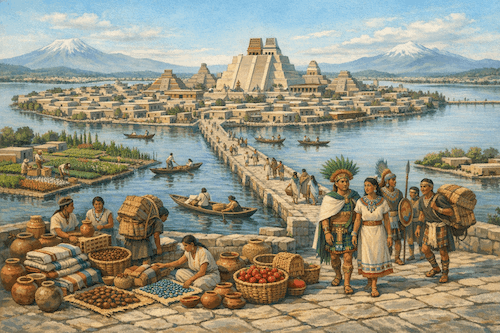
Tenochtitlan: A Legendary CityThe Aztec became a powerful force in the Valley of Mexico during the 1400s. Their capital, Tenochtitlan, was built on islands in Lake Texcoco and grew into one of the largest cities in the Americas.
Tenochtitlan had temples, marketplaces, canals, causeways, and systems for bringing fresh water into the city. Farmers also used chinampas, raised plots of fertile land built in shallow parts of the lake, to grow crops.
According to Aztec tradition, their people were told to establish a city where they saw an eagle perched on a cactus. The eagle, cactus, and snake later became important national symbols of Mexico and appear today on the Mexican flag.
Beginning in the 1400s, the Aztec joined with the cities of Texcoco and Tlacopan in an alliance often called the Aztec Triple Alliance. Together, they expanded their control across much of central Mexico.
Many conquered communities were required to pay tribute. Tribute could include food, cloth, cacao, precious materials, and other goods. This helped make Tenochtitlan wealthy and supported the empire.
Aztec society included rulers, nobles, priests, merchants, farmers, craftspeople, soldiers, and other groups. Education was important, and boys and girls learned skills and responsibilities expected of them in their communities. Military service was especially important for many men, and successful warriors could gain status.
Tenochtitlan also contained large marketplaces where merchants traded food, textiles, pottery, tools, cacao, precious metals, and many other goods. Trade connected the capital to regions across Mesoamerica.
In A.D. 1519, Hernán Cortés arrived in Mexico with Spanish soldiers. Cortés formed alliances with Indigenous peoples who opposed Aztec rule. Warfare, these alliances, and diseases brought from Europe weakened the Aztec Empire. In A.D. 1521, Spanish and allied Indigenous forces captured Tenochtitlan.
The fall of Tenochtitlan ended the Aztec Empire, but it did not erase Aztec or other Indigenous cultures. Indigenous peoples, languages, foods, traditions, and knowledge continued and remain important parts of Mexico today.