
Gerrymandering takes two main forms. Partisan gerrymandering rigs district lines to benefit one political party, using packing and cracking to engineer electoral outcomes. Packing concentrates opposition voters into a few districts where they win by huge margins, wasting their votes. Cracking splits those same voters across multiple districts so they never have enough support to win any of them. Together, these tactics allow a party to win far more seats than its actual share of voters would justify. Since the Supreme Court ruled in Rucho v. Common Cause (2019) that federal courts cannot intervene in partisan gerrymandering cases, it falls largely to states to address the problem on their own.
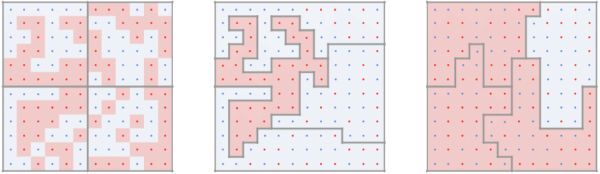
Watch the GIF below. This is a conceptual model of redistricting: in every version, the full map contains the same 12 × 12 grid of 144 total dots, with exactly half red and half blue. Notice that the dots do not change, but the district lines do. Each version has 4 districts, and each district always contains 36 dots, no more, no less. The only thing that changes is where the gray district boundaries are drawn.
The blue and red shading shows which color would win each district based on which color has more dots inside that district.
In the competitive version, each district is split 18 red and 18 blue, so every district would be a tie if everyone voted; turnout would determine the outcome.
In the packing version, district lines are drawn so that many red dots are concentrated, or “packed,” into one district, making that district strongly red while the other three districts each are left with more blue than red, thus giving 3 districts to Blue and 1 to Red.
In the cracking version, red dots are spread across three districts so that red has a small majority in each of those districts, while blue has the majority in the fourth.
This is only one example of how district lines could be drawn. There are many possible ways to divide the same voters into equal-size districts, and different line choices can shift which side is more likely to win.
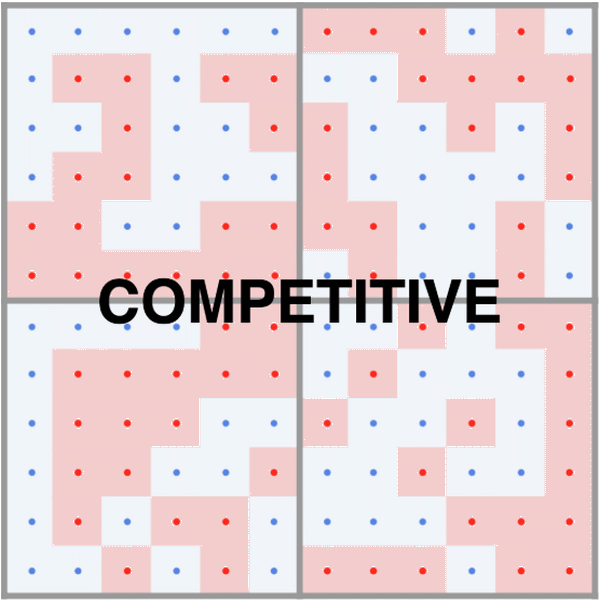
The GIF shows how district lines can be moved to create different partisan outcomes through strategies like packing, cracking, and stacking. But gerrymandering is not only about political party advantage. District lines can also be drawn in ways that target voters by race, which raises separate constitutional concerns.
Racial gerrymandering intentionally draws district lines based on race, which is unconstitutional under the 14th Amendment. The Supreme Court first recognized this claim in Shaw v. Reno (1993), establishing that districts drawn predominantly along racial lines are subject to the highest level of legal scrutiny. In practice, though, race and party affiliation often overlap, and map-drawers increasingly defend racially discriminatory maps by claiming partisan motivation instead, a loophole the Court has left open.
To push back against gerrymandering, reformers have rallied around three redistricting criteria. Compactness and communities of interest both work to keep districts geographically sensible and rooted in real neighborhoods, making it harder to carve up voters arbitrarily. Competitiveness is the third and perhaps most consequential standard. Rather than sorting voters into safe red or blue districts, competitive maps draw districts that reflect a genuine cross-section of the state's population. When politicians face uncertain prospects of winning, they must represent mainstream views. This motivates them to push popular policies rather than just focus on their base.
The stakes are significant. Gerrymandering builds political monopolies that can last for years. It also weakens the voting power of communities of color and drives extreme partisanship, making compromise very hard. When maps are drawn to protect politicians rather than represent people, the entire legislative process suffers.