
After the Louisiana Purchase in 1803, the United States gained a large amount of land west of the Mississippi River. As more settlers moved into these lands, some territories grew large enough to seek permission from Congress to become states. This raised an important question for the young country: how should new states be added to the Union?
By 1819, the United States had a careful balance. Some states allowed the practice of slavery, while other states did not allow the practice of slavery. There were 11 states in each group. This balance mattered because every state had two senators. If one new state entered the Union allowing slavery, then states that allowed slavery would have more power in the Senate. If one new state entered without allowing slavery, then states that did not allow slavery would gain more power.
That same year, Missouri applied for statehood. Missouri had been part of the Louisiana Purchase, and many people living there already practiced slavery. Its request quickly became a national debate. Leaders in the North and South disagreed on Congress's power to limit slavery before Missouri became a state.
Some Northern leaders argued that Missouri should not enter the Union unless it agreed to limit slavery. Representative James Tallmadge of New York proposed a plan, known as the Tallmadge Amendment, that would stop more enslaved people from being brought into Missouri and gradually end slavery there over time. Many Northern lawmakers supported the Tallmadge Amendment because they worried that allowing slavery in Missouri would increase the political power of states that allowed the practice of slavery.

Many Southern leaders strongly opposed this plan. They argued that Congress should not tell a new state whether it could allow the practice of slavery. They believed Missouri should enter the Union with the same rights as other states. Southern leaders also worried that if Congress limited slavery in Missouri, it might later try to limit slavery in other states or territories.
The debate created a deadlock in Congress. The House of Representatives supported limits on slavery in Missouri, but the Senate rejected them. Because the two parts of Congress could not agree, Missouri's statehood bill lapsed, meaning it did not pass before the session ended.
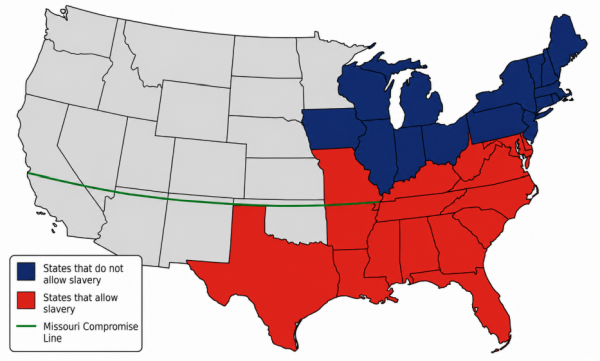
The debate continued when Congress met again. At the same time, Maine also applied for statehood. Speaker of the House Henry Clay helped guide a compromise through Congress. Under the Missouri Compromise, Missouri entered the Union, allowing the practice of slavery, while Maine entered the Union without allowing the practice of slavery. This kept the balance in the Senate. Congress also drew a boundary across the Louisiana Purchase. In most of the territory north of that line, slavery would not be allowed.
The Missouri Compromise was an attempt to solve a difficult political problem and preserve national unity. It showed that leaders could still cooperate, but it also showed that serious disagreements remained.

