
North Africa has long connected different parts of Africa, Europe, and Southwest Asia. Its coastlines, river valleys, deserts, mountains, and trade routes have influenced where people traveled and how societies interacted.
The Sahara created a major physical barrier across the continent, but it did not completely separate North Africa from regions to the south. The Mediterranean Sea connected North African communities with southern Europe and Southwest Asia, while the Nile River created an important route through northeastern Africa.
Because of this location, North Africa became a region where people, goods, languages, religions, and ideas met and changed over time.
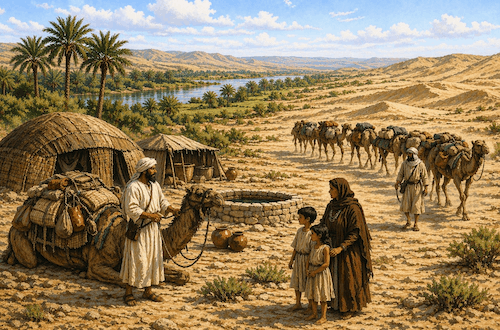
North Africa was already home to many Indigenous peoples, including Amazigh peoples, whose communities developed across much of the region. Over time, migration, trade, conquest, and settlement brought additional peoples into contact with these communities.
Travel across the Sahara became easier with the widespread use of camels. Camels could travel long distances in dry environments and carry people and goods between oases. Caravan routes eventually connected North Africa with societies south of the Sahara and helped move goods such as salt, gold, textiles, and other products across the desert.
North Africa’s location also encouraged movement along the Mediterranean Coast and through the Nile Valley. Geography could create barriers, but it could also create routes that connected societies.
Religion and Cultural DiffusionNorth Africa’s location along major trade and migration routes also helped religions spread.
Christianity reached North Africa during the Roman period and became an important religion in several parts of the region. North Africa was home to major early Christian communities and thinkers, especially in places such as Egypt and areas along the Mediterranean Coast.
Beginning in the 600s CE, Muslim armies and settlers entered North Africa from the east. Over time, Islam spread through conquest, settlement, trade, political change, and conversion. The process took centuries and varied from place to place.
Amazigh communities played an important role in the development of Islamic societies in North Africa. Islam became the dominant religion across most of the region and remains so today.
Later empires and trading networks continued to connect North Africa with Southwest Asia, Europe, and regions south of the Sahara. These connections helped religious ideas, customs, architecture, scholarship, and other cultural traditions spread and change.
North Africa therefore provides an example of cultural diffusion, the spread of cultural ideas and practices from one society to another.
Languages and Cultural ConnectionsThe languages spoken in North Africa also reflect centuries of migration, trade, conquest, and cultural interaction.
Arabic is widely spoken throughout the region and spread significantly after Arab Muslim expansion beginning in the 600s CE. Different forms of spoken Arabic developed in different places, while Modern Standard Arabic is commonly used in formal writing, education, government, and media.
Amazigh languages are also spoken across parts of Morocco, Algeria, Libya, Tunisia, and other areas. Amazigh peoples are Indigenous to North Africa, and their languages have existed in the region for centuries. Today, both Arabic and Tamazight are official languages in Morocco and Algeria.
European colonial rule also left lasting language influences. French remains widely used in parts of Morocco, Algeria, and Tunisia because of their histories under French rule. English and other European languages are also used in education, business, tourism, and international communication in parts of the region.
North Africa’s languages show how geography and history work together. Its location at the meeting point of Africa, Europe, and Southwest Asia created repeated contact among different peoples, and those interactions continue to shape the region’s cultural landscape today.