
By the summer of 1863, the Civil War had been underway for more than two years, and the outcome remained uncertain. Confederate armies had won major victories in the East, including a recent success at Chancellorsville. General Robert E. Lee thought his army could make a strong impact by invading the North. He hoped this would weaken Northern support for the war. At the same time, Union forces under General Ulysses S. Grant were pressing hard against the Confederate stronghold of Vicksburg along the Mississippi River. In early July 1863, two major battles unfolded just days apart, each shaping the direction of the war.
The Battle of Gettysburg
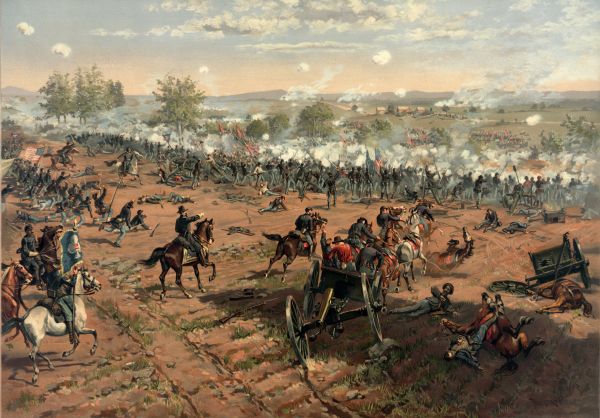
In June 1863, Lee led his army north into Pennsylvania. Confederate soldiers gathered supplies as they moved, and Union forces followed closely. On July 1, fighting erupted near Gettysburg. Confederate troops, in search of supplies, faced off against Union cavalry. What began as a small clash quickly grew as more troops arrived.
During the first day, Confederate forces pushed Union soldiers back through the town. The Union army regrouped on high ground south of Gettysburg. They took positions at Cemetery Hill and Culp’s Hill. On July 2, Confederate attacks struck both sides of the Union line, including heavy fighting at places like Devil’s Den and Little Round Top. Although some Union positions were forced back, the Union army continued to hold the key hills.
On July 3, Lee ordered a large assault on the center of the Union line along Cemetery Ridge. The attack failed, and Confederate troops suffered heavy losses. After three days of battle and many soldiers lost, Lee began his retreat to Virginia. Union forces followed but did not attack as the Confederates withdrew. After Gettysburg, the Confederate strategy of invading the North came to an end, and Lee did not attempt another northern invasion.
The Battle of Vicksburg
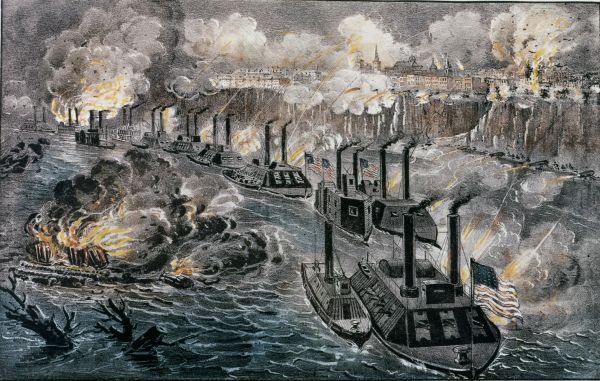
While armies clashed in Pennsylvania, another major campaign was unfolding in the West. Vicksburg was perched on bluffs above the Mississippi River. It was key to controlling travel and supplies. Union leaders believed the war could not end while the Confederacy held the city.
In the spring of 1863, Grant led his army south of Vicksburg and crossed the Mississippi River. Union forces won several battles in Mississippi, pushing Confederate General John C. Pemberton back into the city. Grant launched direct attacks that failed, then surrounded Vicksburg and began a siege.
For 47 days, Confederate soldiers and civilians endured constant shelling, food shortages, and disease as Union forces surrounded the city. On July 4, 1863, Pemberton surrendered Vicksburg, and nearly 29,000 Confederate soldiers laid down their arms, removing a large Confederate force from the war. This surrender gave the Union control of the Mississippi River and made it harder for the Confederacy to move supplies and communicate.
The events of early July 1863 altered the course of the war. It was a moment when both sides began to experience changes.

