
Courts in the United States serve many functions, but not all court cases are the same. Broadly speaking, court cases fall into two main categories: civil cases and criminal cases. Understanding the difference between these two types of cases helps clarify how the judicial branch enforces the rule of law and how it limits government power.
Although civil and criminal cases differ in purpose and structure, both operate within the same larger court system. Trial courts hear cases first. Appeals courts review decisions. At the top of the federal system, the Supreme Court of the United States resolves significant legal and constitutional questions. The type of case—civil or criminal—determines who the parties are, what is at stake, and what the court is being asked to decide.
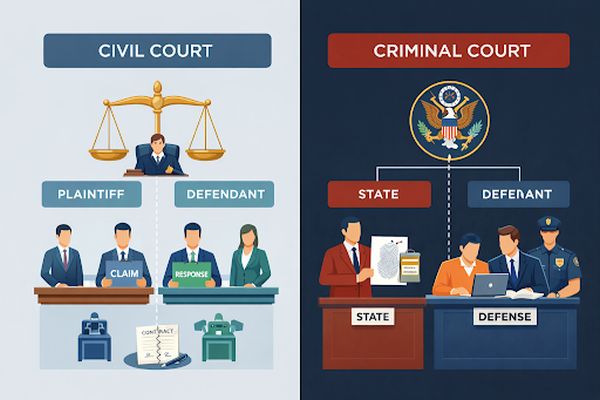
What Is a Civil Case?
A civil case involves a dispute between individuals, organizations, or sometimes between an individual and the government. In civil court, one party claims that another party caused harm or violated a legal obligation.
Common examples of civil cases include:
Contract disputes
Property disagreements
Personal injury claims
Business conflicts
In civil court, the person bringing the case is called the plaintiff, and the person responding is the defendant. The court’s role is not to punish but to resolve the dispute. If the plaintiff proves the claim, the court may order the defendant to pay money damages or take (or stop) a particular action.
Civil cases focus on remedying harm. The goal is compensation or correction, not imprisonment.
What Is a Criminal Case?A criminal case is fundamentally different. In a criminal case, the government brings charges against an individual accused of violating a criminal law. Instead of one private person suing another, the case is formally between the government and the accused individual.
Criminal law involves conduct that society has decided is harmful enough to warrant punishment. The stakes are higher than in civil cases. A criminal conviction can result in fines, probation, or imprisonment.
Because the government has the power to arrest, detain, and punish individuals, criminal cases are structured to require formal proof and defined procedures. The prosecution must demonstrate that a crime occurred and that the accused committed it. If that burden is not met, the accused cannot be convicted.
In criminal court, the goal is not to compensate someone for harm but to determine whether the law was violated and, if so, what punishment is appropriate under that law.
How Civil and Criminal Courts Fit Into the Larger Judicial SystemBoth civil and criminal cases move through similar court structures. At the trial court level, evidence is presented, and facts are determined. If one side believes an error occurred, the case may be appealed to a higher court. Appeals courts review questions of law rather than re-hearing evidence. In rare cases involving significant legal questions, cases may reach a state supreme court or the U.S. Supreme Court.
Most cases—civil and criminal—are resolved at the trial court level. Only a small number are appealed to higher courts. This means that for most people, the trial court is where justice is experienced most directly.
Although the Supreme Court often decides major constitutional questions, the daily work of the judicial branch happens in trial courts across the country, where civil disputes are resolved, and criminal cases are prosecuted.
Why the Difference MattersThe distinction between civil and criminal courts reflects a deeper principle about the role of government.
In civil cases, courts serve primarily as neutral arbiters between private parties. They help resolve disputes and enforce agreements.
In criminal cases, courts oversee the exercise of government power over individuals. When the government accuses someone of committing a crime, it is using its authority to enforce laws and potentially restrict liberty.
If a government claims to follow the rule of law, that claim must be tested most carefully in criminal court. Criminal courts must balance two essential functions at the same time:
Enforcing the law on behalf of society
Protecting individuals from unjust or arbitrary punishment
Both civil and criminal courts are part of the same judicial system. But criminal courts carry a unique responsibility: they are where the government’s most direct power over individuals is exercised.
For the rule of law to be real—not just words—the criminal justice system must operate through defined structures and procedures rather than personal judgment or unchecked authority.
In the next step, you will examine how the criminal justice process operates in practice and consider what structures and procedures help ensure that government power is applied according to law.