
Source 1: The Twenty-Fourth Amendment
Section 1.
The right of citizens of the United States to vote in any primary or other election for President or Vice President, for electors for President or Vice President, or for Senator or Representative in Congress, shall not be denied or abridged by the United States or any State by reason of failure to pay any poll tax or other tax.
Section 2.
The Congress shall have power to enforce this article by appropriate legislation.
Source 2: The Twenty-Fourth Amendment: Debate, Passage, and Legacy
Poll taxes have roots in the earliest decades of American history. Initially, property ownership determined who could vote, and poll taxes eventually replaced property requirements as a qualification for suffrage, in theory expanding access by allowing more citizens to participate. By the mid-nineteenth century, most states had abandoned such requirements entirely. However, following Reconstruction, all former Confederate states reimposed poll taxes as part of a deliberate effort to undermine the Fifteenth Amendment. Combined with literacy tests and felon disenfranchisement, poll taxes succeeded in dramatically suppressing Black voter registration and turnout. Though the taxes were often nominal, their cumulative administration made them a serious burden, and the Supreme Court repeatedly upheld their constitutionality through the 1950s.
By 1962, only five states retained poll taxes, but the Civil Rights Movement had placed voting rights at the center of national debate. Congress had attempted to abolish the poll tax for decades, dating back to 1939, but efforts repeatedly stalled. Two arguments shaped the final debate. First, many in Congress believed voter qualifications were reserved to the states, making a constitutional amendment necessary rather than a statute. Second, the amendment was limited to federal elections as a concession to states' rights advocates, a compromise that secured enough votes for passage.
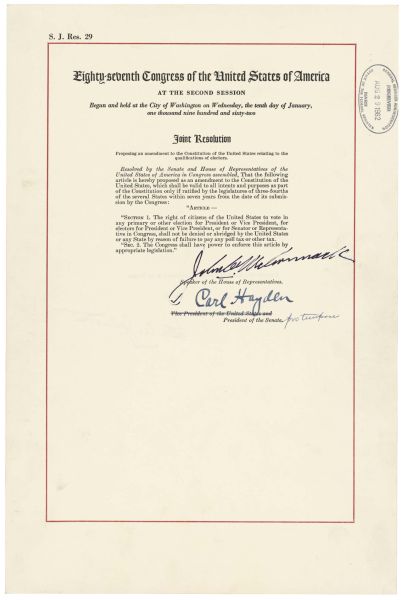
The amendment's path was complicated by an unlikely source of opposition. The NAACP initially urged senators to vote against it, fearing that pursuing a constitutional remedy would legitimize segregationists' argument that only an amendment could lawfully address poll taxes. Despite this opposition, Congress passed the Twenty-Fourth Amendment in 1962, and it was ratified in 1964. Virginia immediately attempted to circumvent it, but the Supreme Court struck down the workaround in Harman v. Forssenius. Two years later, in Harper v. Virginia Board of Elections, the Court extended the prohibition to state and local elections under the Equal Protection Clause.
The Twenty-Fourth Amendment's legacy extends beyond the elimination of poll taxes. It remains one of the few achievements of the Civil Rights Movement embedded directly in the Constitution, and its language continues to shape litigation over indirect voting costs, including voter identification requirements and restrictions on formerly incarcerated citizens seeking to restore their voting rights.
Source 3: Excerpt from Remarks Upon Witnessing the Certification of the 24th Amendment to the Constitution: Speech of President Lyndon B. Johnson, February 4, 1964.
“TODAY, the United States witnesses the triumph of liberty over restriction. Today, the people of this land have abolished the poll tax as a condition to voting. By this act they have reaffirmed the simple but unbreakable theme of this Republic. Nothing is so valuable as liberty, and nothing is so necessary to liberty as the freedom to vote without bans or barriers.
Our Constitution in its 175-year lifetime has been amended but 14 times following the ratification of the Bill of Rights. A change in our Constitution is a serious event. The beneficiaries of this amendment are the people of this land.
There can now be no one too poor to vote. There is no longer a tax on his rights. The only enemy to voting that we face today is indifference. Too many of our citizens treat casually what other people in other lands are ready to die for.
Less than two-thirds of our eligible population cast ballots in the 1960 presidential election. Perhaps this specific act of firm resolve will turn negligence into interest. I pray that this is so.”
Source 4: Excerpt from the Congressional Record: Address of Senator Strom Thurmond of South Carolina on the Abolition of the Poll Tax, January 1960.
“Mr. President, the issue presented by the pending amendment is not whether the poll tax is an evil, is outmoded, or is a boon to good government. The issue presented is whether we shall uphold the Constitution and one of the few remaining rights of the states -- that of prescribing the qualifications of electors. In the beginning, let me point out to you that I personally am no advocate of the poll tax as a qualification for voting.
. . .
I am opposed to the pending amendment which would repeal the poll tax as an elector qualification by statutory action of the Congress for two reasons. First, it is clearly and palpably unconstitutional. If the five poll tax States are to be forced against their will to eliminate the poll tax qualification for voting, then the proper procedure to follow is to amend the Constitution of the United States in the manner provided for in Article V of the Constitution. Second, it is unwise. This is another attempt to force the views of some people from other sections of this country on a portion of an already persecuted section.
. . .
The privilege of voting is not a right conferred on every citizen by the United States Government or the Constitution of the United States. The privilege of voting is derived from and conferred by the States, and this power of the States can be limited or restricted only in as much as the States agree by constitutional amendment that this power be limited or restricted by the Constitution of the United States.”
