
Section 1.
Neither slavery nor involuntary servitude, except as a punishment for crime whereof the party shall have been duly convicted, shall exist within the United States, or any place subject to their jurisdiction.
Section 2.
Congress shall have power to enforce this article by appropriate legislation.
Source 2: The Thirteenth Amendment: Debate, Passage, and Legacy
The debate over abolishing slavery did not begin with Abraham Lincoln. By 1863, Radical Republicans in Congress were already pushing for a constitutional amendment that would permanently end slavery, arguing that Lincoln's Emancipation Proclamation did not go far enough. The Proclamation, issued on January 1, 1863, freed only enslaved people in Confederate states where the Union had no real authority to enforce it. Abolitionists in Congress wanted what they called a constitutional guarantee of permanent freedom, one that no future president or Congress could undo. The Senate passed the amendment in April 1864 by a wide margin, but the House struggled. Two votes failed before Lincoln, newly reelected, applied political pressure on holdouts. On January 31, 1865, the House finally passed the Thirteenth Amendment. Ratification by the states followed, and on December 6, 1865, the amendment became law.
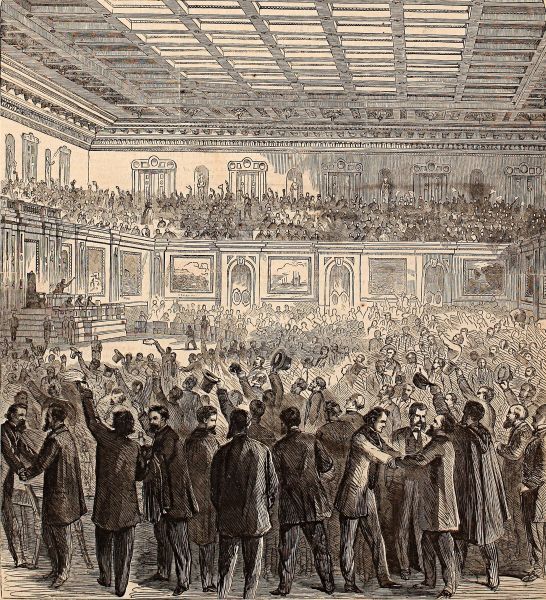
The debate in Congress was not simply about whether slavery should end. Senators argued over the constitutionality of uncompensated emancipation, the limits of federal power, and what abolition would actually mean for formerly enslaved people. Radical Republicans pushed for language guaranteeing full equality before the law, but that language was rejected. What passed was more limited: slavery and involuntary servitude were prohibited, except as punishment for a crime. That exception clause was not an accident. It reflected the political compromises required to build enough support for ratification, and it would have lasting consequences for how the amendment was interpreted and applied.
The Thirteenth Amendment did something no previous constitutional provision had done — it directly constrained the behavior of private individuals, not just the government. It also gave Congress the power to pass legislation targeting the "badges and incidents of slavery," a phrase the Supreme Court has never fully defined. In practice, the amendment's reach was immediately limited. Southern states responded with Black Codes that effectively re-enslaved Black Americans through debt, contract labor, and criminal punishment. The amendment had ended chattel slavery, but it had not resolved the deeper questions of citizenship, equality, and power that would fuel a century of continued struggle.
Source 3: Excerpt from Senator Charles Sumner, Congressional Debate on the Thirteenth Amendment, 1864
“... There is nothing in the Constitution on which slavery can rest, or find any the least support. Even on the face of that instrument, it is an outlaw; but if we look further at its provisions we find at least four distinct sources of power, which, if executed, must render slavery impossible, while the preamble makes them all vital for freedom: first, the power to provide for the common defense and welfare; secondly, the power to raise armies and maintain navies; thirdly, the power to guaranty to every State a republican form of government; and fourthly, the power to secure liberty to every person restrained without due process of law. But all these provisions are something more than powers; they are duties also.
And yet we are constantly and painfully reminded in this Chamber that pending measures against slavery are unconstitutional. Sir, this is an immense mistake. Nothing against slavery can be unconstitutional. It is only hesitation which is unconstitutional. And yet slavery still exists—in defiance of all these requirements of the Constitution; nay, more, in defiance of reason and justice, which can never be disobeyed with impunity—it exists, the perpetual spoiler of human rights and disturber of the public peace, degrading master as well as slave, corrupting society, weakening government, impoverishing the very soil itself, and impairing the natural resources of the country. Such an outrage, so offensive in every respect, not only to the Constitution, but also to the whole system of order by which the universe is governed, is plainly a national nuisance, which, for the general welfare and in the name of justice, ought to be abated. But at this moment, when it menaces the national life, it will not be enough to treat slavery merely as a nuisance; for it is much more. It is a public enemy and traitor wherever it shows itself, to be subdued, in the discharge of solemn guaranties of Government and of personal rights, and in the exercise of unquestionable and indefeasible rights of selfdefence. . . . But whether regarded as national nuisance or as public enemy and traitor, it is obnoxious to the same judgment, and must be abolished…”
Source 4: Source 4: Excerpt from Senator Lazarus Powell, Congressional Debate on the Thirteenth Amendment, 1864
“...I do not believe it was ever designed by the founders of our Government that the Constitution of the United States should be so amended as to destroy property. I do not believe it is the province of the Federal Government to say what is or what is not property. Its province is to guard, protect, and secure, rather than to destroy. If you admit the principle contended for by the gentlemen who urge this amendment, logic would lead them to the conclusion that the General Government could, by an amendment to its Constitution, regulate every domestic matter in the States. If it, by constitutional amendment, can regulate the relation of master and servant, it certainly can, on the same principle, make regulations concerning the relation of parent and child, husband and wife, and guardian and ward. If it has the right to strike down property in slaves, it certainly would have a right to strike down property in horses, to make a partition of the land, and to say that none shall hold land in any State in the Union in fee simple. . . .
But it is said slavery is the cause of the war, and because it is the cause of the war it must die. If that is the kind of logic on which honorable Senators act they could destroy almost everything that is pure, good, and holy in the world. The blessed religion of our Saviour has been the pretext of more wars perhaps than any other subject. Why not strike down the Christian religion because it has been the subject-matter about which throats have been cut, cities sacked, and empires overthrown? There have been furious wars about territory and territorial boundaries, and there will continue to be such wars as long as the cupidity of man prompts him to make conquests. Why not destroy all tenure in land? Ferocious wars have been waged about women. In Homeric verse we have the historical record of a ten years’ contest for frail Helen. Why not destroy the loveliest of God’s handiwork. . . .
. . .I desire the Union to be restored, restored as it was with the Constitution as it is; and I verily believe that if you pass this amendment to the Constitution it will be the most effective disunion measure that could be passed by Congress. . . .
. . .
. . . You seem to care for nothing but the negro. That seems to be your sole desire. You seem to be inspired by no other wish than to elevate the negro to equality and give him liberty. . . . I believe this government was made by white men and for white men; and if it is ever preserved it must be preserved by white men. . . . I would ask the Senators who are so zealous for the negro to point me to a place on the earth where he has been so civilized, so humanized, so christrianized, so well cared for as he is in a state of slavery in the United States of America. He has existed, I suppose, as long as the other peoples of the earth; but if you were today to strike from existence everything that the woolly-headed negro has given to art, to science, to the mechanic arts, to literature, or to any of the industrial pursuits, the world would not miss it. He is an inferior man in his capacity, and no fanaticism can raise him to the talent of the Caucasian race. The white man is his superior, and will be so whether you call him a slave or an equal. It has ever been so, and I can see no reason why the history of all the past should be reversed…”
