
Source 1: The Seventeenth Amendment
The Senate of the United States shall be composed of two Senators from each State, elected by the people thereof, for six years; and each Senator shall have one vote. The electors in each State shall have the qualifications requisite for electors of the most numerous branch of the State legislatures.
When vacancies happen in the representation of any State in the Senate, the executive authority of such State shall issue writs of election to fill such vacancies: Provided, That the legislature of any State may empower the executive thereof to make temporary appointments until the people fill the vacancies by election as the legislature may direct.
This amendment shall not be so construed as to affect the election or term of any Senator chosen before it becomes valid as part of the Constitution.
Source 2: The Seventeenth Amendment: Debate, Passage, and Legacy
When the delegates to the Constitutional Convention met in Philadelphia in 1787, they made a deliberate choice about how the United States Senate would be formed. Rather than allowing voters to elect senators directly, the framers assigned that power to state legislatures. This arrangement reflected a philosophical commitment to insulating the Senate from the passions of the public and cementing the relationship between state governments and the new federal government. James Madison argued that the system provided a "double advantage," both favoring careful selection and giving states a meaningful role in shaping the federal government.
For decades, the system functioned as designed. However, beginning in the mid-nineteenth century and accelerating after the Civil War, serious problems emerged. Fierce partisan battles within state legislatures frequently produced deadlocks, leaving Senate seats vacant for months or even years. Between 1891 and 1905, 45 deadlocks occurred across 20 states. In Delaware alone, the legislature cast 113 votes over 64 days in 1899 without electing a senator, leaving the seat empty for four years. Beyond deadlock, allegations of bribery and corruption in Senate elections became increasingly common. Progressive reformers charged that state legislatures had become instruments of powerful private interests and political machines rather than representatives of the public will.
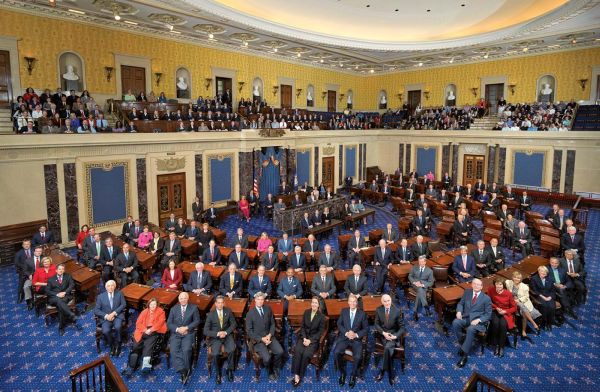
Reform efforts built steadily over several decades. Many states adopted the so-called Oregon System, under which voters could express a preference for Senate candidates in direct primaries, with state legislative candidates pledging to honor the results. By 1908, more than half of all states had adopted some version of this approach. In 1906, journalist David Graham Phillips published a widely read expose titled "The Treason of the Senate," which charged that corporate interests were corrupting the selection process and dramatically increased public pressure for a constitutional solution.
Congress responded. The House passed proposed amendments providing for the direct election of senators multiple times between 1893 and 1912. The Senate ultimately approved the measure in 1912 by a bipartisan vote of 64 to 24. Ratified on April 8, 1913, the Seventeenth Amendment transferred the power to elect United States senators from state legislatures to the voters of each state, fundamentally reshaping the relationship between American citizens and their federal government.
Source 3: Excerpt from Senator Joseph L. Bristow, Resolution for the Direct Election of Senators, 1912
“... With the development during recent times of the great corporate interests of the country, and the increased importance of legislation relating to their affairs, they have tenaciously sought to control the election of Senators friendly to their interests. The power of these great financial and industrial institutions can be very effectively used in the election of Senators by legislatures, and they have many times during recent years used that power in a most reprehensible and scandalous manner. They have spent enormous amounts of money in corrupting legislatures to elect to the Senate men of their own choosing.
Through the influence of the Senators so elected, who have become known as corporation Senators, legislation to control the trusts and monopolies has been smothered in committees and defeated in the Senate. Under the operation of our political institutions Senators exercise great influence in the appointment of Federal judges; and by controlling the election of Senators these great interests have to a large extent been able to secure the appointment of judges who are more devoted to their interests than to the public welfare. These various abuses have been responsible for the rapid growth of the sentiment for a change in the method of electing Senators and for the adoption of a method that would make the power of the great financial interests less potent.
So, as I said in the beginning, the first session of this Congress is made historic by passing through the Senate a resolution for the direct election of Senators by the people. The historian will record that in 1911, 85 years after the first resolution was introduced in the House of Representatives, a joint resolution providing for an amendment to the Constitution changing the method of electing Senators passed the Senate for the first time. The narrative of its passage, its imprisonment in a conference committee, and its final passage is an interesting story…”
Source 4: Excerpt from the Congressional Record, 62nd Congress, 1st Session: Speech of Senator Porter McCumber of North Dakota, June 12, 1911
“Mr. President, this proposed amendment to the Constitution, if adopted, will measure a great advance in the drift of our form of government from the representative establishment, by which the democratic idea of to-day. It presupposes either a changed condition of our people regarding a modification of that document, or an error which has always been in it. The framers of the Constitution, careful in their judgment of the form of government they intended to establish and in seeking to establish that form of government which should give to each individual of the mass complete and as direct a participation in all the affairs of government as should be consistent with national safety and stability.
They aimed to create a government by the people which should at all times assure the liberties of its citizens and protect them in the enjoyment of the fruits of their industry. Before them as they labored were the models of all old republics, and in their hands were the histories which recorded their ruin. They recognized the fundamental truth that the liberty of the government ever rests upon the stability of the government; that stability and strength cannot grow out of the freedom of a few irresponsible and profligate. They were fearful alike of the rigid and selfish autocracy of an absolute monarchy on the one side, and the erratic excesses of an absolute democracy on the other. They adopted, therefore, as the foundation of their structure the republican or representative idea of government, which should embody the strength and durability of the one and avoid the dangers and excesses of the other.
The fundamental idea of a course was a government by the people, the source of all governing power and authority, but though the instrumentality of elected representatives, who were selected because of their superior knowledge of governmental affairs and requirements, and yet whose tenure of office would at all times compel them to recognize public demands and sentiment… “
