
Source 1: The Fourteenth Amendment
Section 1.
All persons born or naturalized in the United States, and subject to the jurisdiction thereof, are citizens of the United States and of the State wherein they reside. No State shall make or enforce any law which shall abridge the privileges or immunities of citizens of the United States; nor shall any State deprive any person of life, liberty, or property, without due process of law; nor deny to any person within its jurisdiction the equal protection of the laws.
Section 2.
Representatives shall be apportioned among the several States according to their respective numbers, counting the whole number of persons in each State, excluding Indians not taxed. But when the right to vote at any election for the choice of electors for President and Vice-President of the United States, Representatives in Congress, the Executive and Judicial officers of a State, or the members of the Legislature thereof, is denied to any of the male inhabitants of such State, being twenty-one years of age,* and citizens of the United States, or in any way abridged, except for participation in rebellion, or other crime, the basis of representation therein shall be reduced in the proportion which the number of such male citizens shall bear to the whole number of male citizens twenty-one years of age in such State.
Section 3.
No person shall be a Senator or Representative in Congress, or elector of President and Vice-President, or hold any office, civil or military, under the United States, or under any State, who, having previously taken an oath, as a member of Congress, or as an officer of the United States, or as a member of any State legislature, or as an executive or judicial officer of any State, to support the Constitution of the United States, shall have engaged in insurrection or rebellion against the same, or given aid or comfort to the enemies thereof. But Congress may by a vote of two-thirds of each House, remove such disability.
Section 4.
The validity of the public debt of the United States, authorized by law, including debts incurred for payment of pensions and bounties for services in suppressing insurrection or rebellion, shall not be questioned. But neither the United States nor any State shall assume or pay any debt or obligation incurred in aid of insurrection or rebellion against the United States, or any claim for the loss or emancipation of any slave; but all such debts, obligations and claims shall be held illegal and void.
Section 5.
The Congress shall have power to enforce, by appropriate legislation, the provisions of this article.
Source 2: The Fourteenth Amendment: Debate, Passage, and Legacy
The Fourteenth Amendment was born directly out of the failure of the Thirteenth. After slavery was abolished in 1865, southern states responded with Black Codes — laws designed to strip newly freed African Americans of basic civil rights and keep them in conditions that closely resembled enslavement. The Supreme Court's earlier ruling in Dred Scott v. Sanford had declared Black Americans were not citizens, and that decision remained on the books. Radical Republicans in Congress pushed for an amendment that would overturn Dred Scott, invalidate the Black Codes, and establish a constitutional guarantee of citizenship and equal protection for all people born or naturalized in the United States.
The path to ratification was not smooth. Most southern states refused to ratify, and those who advocated for the amendment faced violence and retaliation. Congress ultimately required southern states to ratify the Fourteenth Amendment as a condition of readmission to the Union, a requirement that drew fierce opposition from those who argued the process itself was unconstitutional.
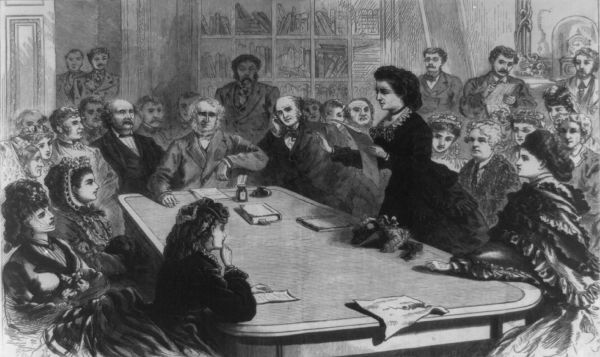
The debate over the amendment extended beyond questions of race. Section 2 of the Fourteenth Amendment addressed the consequences for states that denied men the right to vote, and in doing so, introduced the word "male" into the Constitution for the first time. While the amendment did not grant voting rights to anyone, the language made it clear that constitutional protections governing voting were written specifically for men, which outraged many women's rights advocates. The suffrage movement split over whether to support the amendment despite that exclusion. Some, including Sojourner Truth and Julia Ward Howe, supported ratification as a necessary step toward equality. Others, including Susan B. Anthony and Elizabeth Cady Stanton, opposed it on the grounds that it explicitly wrote women out of constitutional protections
The Fourteenth Amendment's impact on constitutional law has been broader and more lasting than perhaps any other amendment. The Equal Protection Clause was used to challenge Jim Crow segregation, ultimately succeeding in Brown v. Board of Education in 1954. Its Due Process Clause became the basis for incorporating the Bill of Rights to apply to state governments, and for establishing a constitutional right to privacy that shaped landmark decisions on reproductive rights and marriage equality. Nearly 160 years after ratification, the amendment remains one of the most contested and consequential texts in American constitutional history.
Source 3: Excerpt from Thaddeus Stevens, Speech Introducing the Fourteenth Amendment, 1866
“...But I beg gentlemen to consider the magnitude of the task which was imposed upon the committee. They were expected to suggest a plan for rebuilding a shattered nation . . . Our fathers had been compelled to postpone the principles of their great Declaration, and wait for the full establishment till a more propitious time. That time ought to be present now. But the public mind has been educated in error for a century. How difficult in a day to unlearn it.
…
I can hardly believe that any person can be found who will not admit that every one of these provisions is just. They are all asserted, in some form or other, in our Declaration or organic law. But the Constitution limits only the action of Congress, and is not a limitation on the States. This amendment supplies that defect, and allows Congress to correct the unjust legislation of the States, so far that the law which operates upon one man shall operate equally upon all. Whatever law punishes a white man for a crime shall punish the black man precisely in the same way and to the same degree. Whatever law protects the white man shall afford equal protection to the black man. Whatever means of redress is afforded to one shall be afforded to all. Whatever law allows the white man to testify in court shall allow the man of color to do the same. . . . Unless the Constitution should restrain them, those States will all, I fear, keep up this discrimination and crush to death the hated freedmen. . . . This amendment once adopted cannot be annulled without two thirds of Congress."
Source 4: Excerpt from the Congressional Globe, 39th Congress, 1st Session: Speech of Senator Edgar Cowan of Pennsylvania, May 30, 1866
“… I have no doubt, a good deal of his attention, and I am really desirous to have a legal definition of "citizenship of the United States." What does it mean? What is its length and breadth? I would be glad if some Senator who has a good ear most would favor me with some such definition. Is the child of the Chinese immigrant in California a citizen? Is a Gypsy born in Pennsylvania a citizen? If so, what rights have they? Have they any more rights than a foreigner in the United States? If a traveler comes here from Ethiopia, from Australia, or from Great Britain, he is entitled, to a certain extent, to the protection of the laws. You cannot murder him with impunity. It is murder to kill him, the same as it is to kill another man. If you commit an assault and battery on him, I apprehend. He has a right to the protection of the laws; but he is not a citizen in the ordinary acceptation of the word.
It is perfectly clear that the mere fact that a man is born in the country has not heretofore entitled him to the right to exercise political power. He has not been entitled, by virtue of that, to be an elector. An elector is one who is chosen by the people to perform that function, just the same as an officer is one chosen by the people to exercise the franchises of his office. Now, I should like to know, because really I have been unable to determine exactly, either from conversation with those who ought to know, who have given this subject their attention, or from the decisions of the Supreme Court, the lines and boundaries which circumscribe that phrase, "citizen of the United States." What is it?
. . . I have supposed, further, that it was essential to the existence of society itself, and particularly essential to the existence of a free State, that it should have the power, not only of declaring who should exercise political power within its boundaries, but that if it were overrun by another and a different race, it would have the right to absolutely expel them. . . . Therefore I think, before we assert broadly that every person born in the limits of the United States shall be taken to be a citizen of the United States, we ought to exclude other nations…”
