
Source 1: The Fifteenth Amendment
Section 1.
The right of citizens of the United States to vote shall not be denied or abridged by the United States or by any State on account of race, color, or previous condition of servitude--
Section 2.
The Congress shall have power to enforce this article by appropriate legislation.
Source 2: The Fifteenth Amendment: Debate, Passage, and Legacy
By the time Ulysses S. Grant was elected president in 1868, the question of Black voting rights had become one of the most urgent unresolved problems of Reconstruction. The Reconstruction Acts, passed after the Civil War, required Southern states to allow Black men to vote, but that requirement did not apply to the North, where eleven of twenty-one states still prohibited Black suffrage. Republicans in Congress recognized that without a constitutional amendment, voting rights for Black Americans remained vulnerable to shifting political winds.
Three versions of the amendment were debated. The first prohibited denying the vote on the basis of race, color, or previous condition of servitude. The second would have also barred discrimination based on literacy or property. The third would have simply declared that all male citizens twenty-one or older had the right to vote. Congress adopted the most moderate version, judging it the most likely to achieve ratification, though many warned that its narrow language left room for abuse.
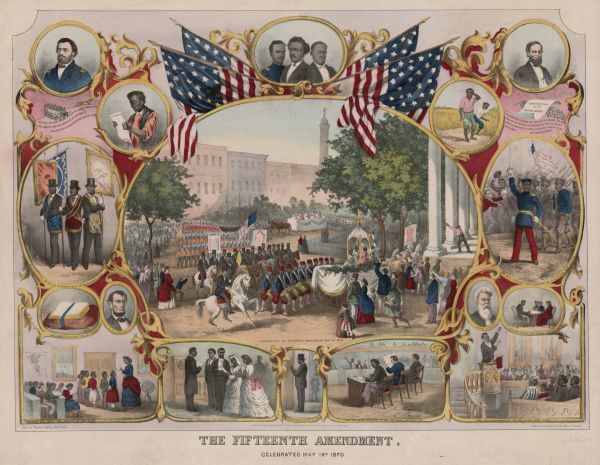
Ratification was not guaranteed. Several Democratic states rejected the amendment outright, and Congress fell short of the number needed to make it law. The solution came from the South, where states seeking readmission to the Union were required by Congress to ratify the amendment as a condition for rejoining the Union. With that leverage, the Fifteenth Amendment was ratified on February 3, 1870. Black men across the country exercised the right to vote, and Black candidates were elected to state legislatures and to both chambers of Congress.
The legacy of the Fifteenth Amendment is one of both achievement and failure. Almost immediately, Southern states constructed legal barriers designed to nullify it without technically violating it. Literacy tests, poll taxes, grandfather clauses, and campaigns of violence and intimidation effectively stripped Black Americans of the vote for nearly a century. It was not until the Voting Rights Act of 1965 that the federal government moved aggressively to enforce the amendment's original promise. The Fifteenth Amendment established a constitutional guarantee that has never been fully realized, and its history remains inseparable from the ongoing fight for equal access to the ballot.
Source 3: Excerpt from the Congressional Globe, 40th Congress, 3rd Session: Speech of Senator William Stewart of Nevada, January 28, 1869
“Mr. President, I do not propose to occupy the time of the Senate in discussing this great question at length. It is the culmination of a contest which has lasted for thirty years. It is the logical result of the rebellion, of the abolition of slavery and of the conflicts in this country during and before the war. Every person in the country has discussed it; it has been discussed in every social paper, by every local speaker; it has been discussed at the fireside; and now we are to place the grand result, I hope, in the Constitution of the United States. And let me remind my fellow-Senators that it is well that this work be done, for we have realized the force of the very pointed sentence which was read here from the Swiss address, that “under democratic institutions no pity for the repose of mankind.” This question can never rest until it is finally disposed of. This amendment is a declaration to make all men, without regard to race or color, equal before the law. The sentiment is in favor of it; there are no murmurs, so convincing that they carry conviction to every mind. This proposition itself has been recognized by the good men of this nation; and it is important, as the new administration enters upon the charge of the affairs of this country, that it should start on this high and noble principle that all men are free and equal, that they are really equal before the law. We cannot stop short of this.
It must be done. It is the only measure that will really abolish slavery. It is the only guarantee against peace and against oppression. It is that guarantee which was put in the Constitution of the United States originally, the guarantee that each man shall have a right to protect his own liberty. It repudiates the arrogant, self-righteous assumption that one man can be charged with the liberties of another. You may put this in the form of legislative enactment; you may empower Congress to legislate; you may empower the States to legislate, and they will agitate the question. Let it be made eminent in the table law of the land; let it be fixed; and then we shall have peace. Until then there is no peace. I cannot add to the many eloquent speeches that have been made on this great question in this House. I will simply ask that the proposition itself is more to occupy time. The more it can be. It is a declaration so light, so grand, so noble, too just, to be ornamented by oratory. I hope we shall soon have a vote upon the question…”
Source 4: Excerpt from the Congressional Globe, 40th Congress, 3rd Session: Speech of Senator James Dixon of Connecticut, January 29, 1869
“... What is the question? It is not merely a question of suffrage. That of itself is a subject of vast importance, and now an agitating one in the public mind of this country to a very great extent. The question whether the female sex should be permitted to participate in the privilege of suffrage, whether other restrictions should be removed, the question of age, the question of property, a multitude of questions are or may be raised which are wholly important and interesting in connection with the right of suffrage. But, sir, we are not now dealing merely with the qualification of voters. The question is not what shall be the qualifications of the voter, but who shall create, establish, and prescribe those qualifications; not who shall be the voter, but who shall make the voter.
In considering that question we ought to remember that it is utterly impossible that any State should be an independent republic which does not entirely control its own laws with regard to the right of suffrage. Nor does it make the slightest difference with regard to this that any abdication or abnegation of its power is voluntary. It may be said that it is proposed that the States shall voluntarily relinquish their power to control the subject of suffrage within their respective limits. Sir, suppose a State should voluntarily assume upon itself a foreign yoke, or declare by a majority of its own people, or even by a unanimous vote, that it would prefer a monarchy, would the fact of it being voluntary at all affect the question whether it was still an independent republic?
Now, sir, it may be that the people of this country in their present condition of mind are ready to relinquish the power in the States regulating their own laws with regard to suffrage. . . . Nevertheless they would by that action lose their character as republican governments. And, sir, this is the reason why it was that in the formation of the Constitution of the United States there was an entire neglect to interfere in the slightest degree with the question of suffrage in the several States.”
